
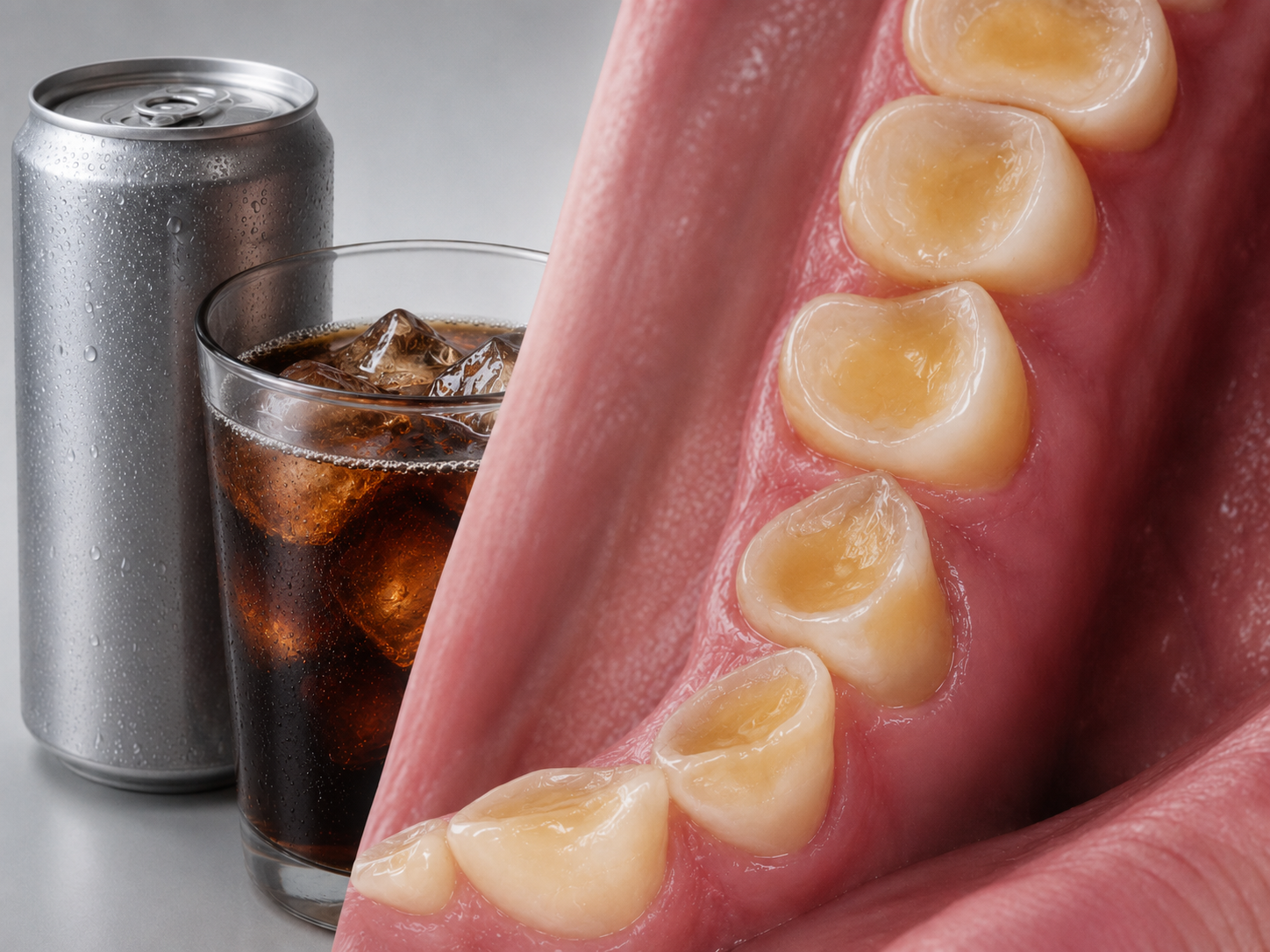
Walk into any dental school clinic and you will find at least one patient who swears their diet is fine — they only drink cola, not those "chemical" energy drinks. The distinction feels intuitive. It is also, from an enamel erosion standpoint, largely wrong.
01The EvidenceWhat the Research Actually Shows
Scanning electron microscopy studies comparing Red Bull, Gatorade, Coca-Cola Classic, and Diet Coke on extracted human molars place the erosive order unambiguously: Red Bull > Gatorade > Coca-Cola Classic > Diet Coke. After 14 days of continuous immersion, Red Bull and Gatorade produced the most striking surface morphological changes — prismatic structure loss, surface pitting, and irregular post-treatment topography that cola beverages simply did not match at the same exposure time.
A separate enamel dissolution study using weight-loss measurement over 14 days confirmed the same hierarchy: flavoured and energy drinks caused far greater enamel attack than cola drinks. Critically, the study found no significant correlation between beverage pH and the degree of enamel dissolution — meaning pH alone does not predict erosive damage, and clinicians who reassure patients based on pH comparisons are working with an incomplete picture.
02The ChemistryWhy Energy Drinks Hit Harder
Cola beverages are primarily acidified with phosphoric acid, which has a relatively high pKa and a degree of natural calcium buffering from the phosphate ions already present in solution. Energy drinks, by contrast, typically combine citric acid and malic acid — both of which chelate calcium ions from the enamel surface more aggressively than phosphoric acid does. Citric acid in particular forms soluble calcium-citrate complexes, stripping mineral from the hydroxyapatite lattice faster than the saliva can remineralise it.
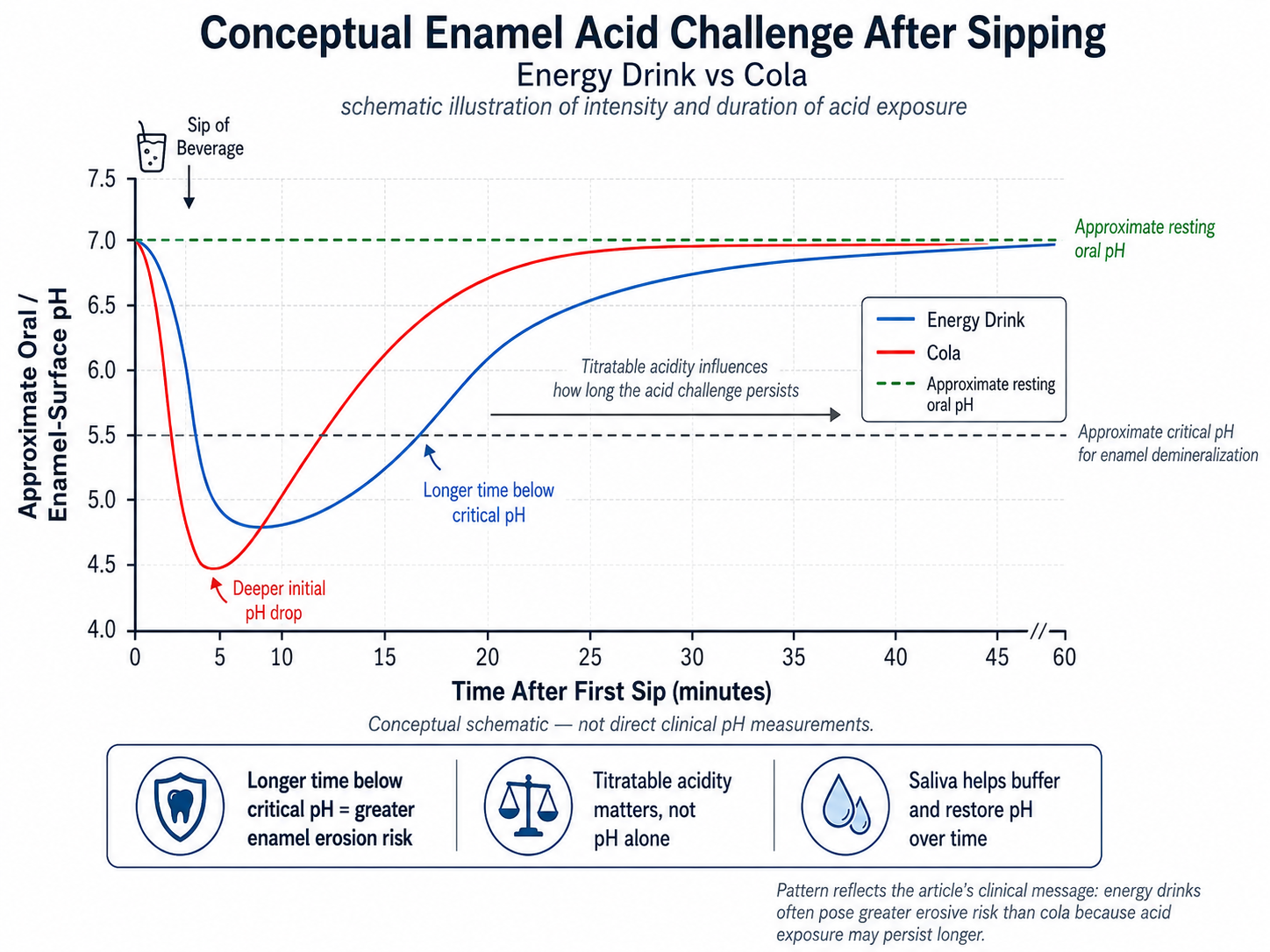
Titratable acidity — the total acid load a beverage can deliver before being neutralised — is consistently higher in energy drinks than in cola. This matters because the mouth does not experience a single pH snapshot; it experiences a sustained acid challenge until salivary buffering restores neutrality. A drink with a higher titratable acidity keeps the oral environment below the critical pH for enamel dissolution (approximately 5.5) for longer.
03TaurineDoes It Matter for Teeth?
Taurine — the amino acid that became synonymous with energy drinks after Red Bull popularised it in the 1990s — has no direct erosive effect on dental hard tissues. It is not an acid, it does not chelate calcium, and its presence in a beverage does not meaningfully alter the drink's erosive potential. From a purely dental perspective, taurine is a passenger, not a driver.
That said, taurine is worth mentioning in patient education for a different reason: it signals the category of drink. Patients who see taurine on the label are holding a product that almost certainly also contains citric acid, a high sugar or sweetener load, and a titratable acidity profile that outpaces most colas. The ingredient is a useful proxy for the conversation — not because taurine itself damages teeth, but because its presence reliably co-occurs with the ingredients that do.
04ChairsideWhat to Tell Your Patients
The practical message is straightforward: energy drinks are not a safer alternative to cola for dental health. If a patient has switched from cola to energy drinks believing they are making a better choice for their teeth, that assumption needs correcting.
- Frequency and contact time matter more than total volume. Sipping an energy drink over 45 minutes is far more damaging than drinking it in one go.
- Rinsing with water immediately after reduces acid contact time and supports salivary clearance — a simple, evidence-backed recommendation.
- Waiting 30–60 minutes before brushing after any acidic beverage prevents mechanical abrasion of softened enamel.
- Straw use reduces palatal and labial enamel exposure, though it does not eliminate erosive risk entirely.
- For patients with existing erosion, the conversation about energy drinks is at least as important as the one about cola — and arguably more urgent.
Reduced residence times of beverages in the mouth — through salivary clearance or rinsing — appear to be beneficial in limiting enamel dissolution from energy and sports drinks.
von Fraunhofer & Rogers · General Dentistry, 2005
The takeaway for clinical practice: stop treating cola as the default villain in erosion conversations. Energy drinks have earned that title, and the microscopy data backs it up.

👨⚕️ doc. MUDr. Radek Mounajjed DDS., PhD. 🦷 D.C.M. Clinic 🎓 Associate Professor, Palacký University Olomouc, Czech Republic 📚 CICERO Cofounder ⚖️ Certified Court Expert in Dentistry
View educator profile