
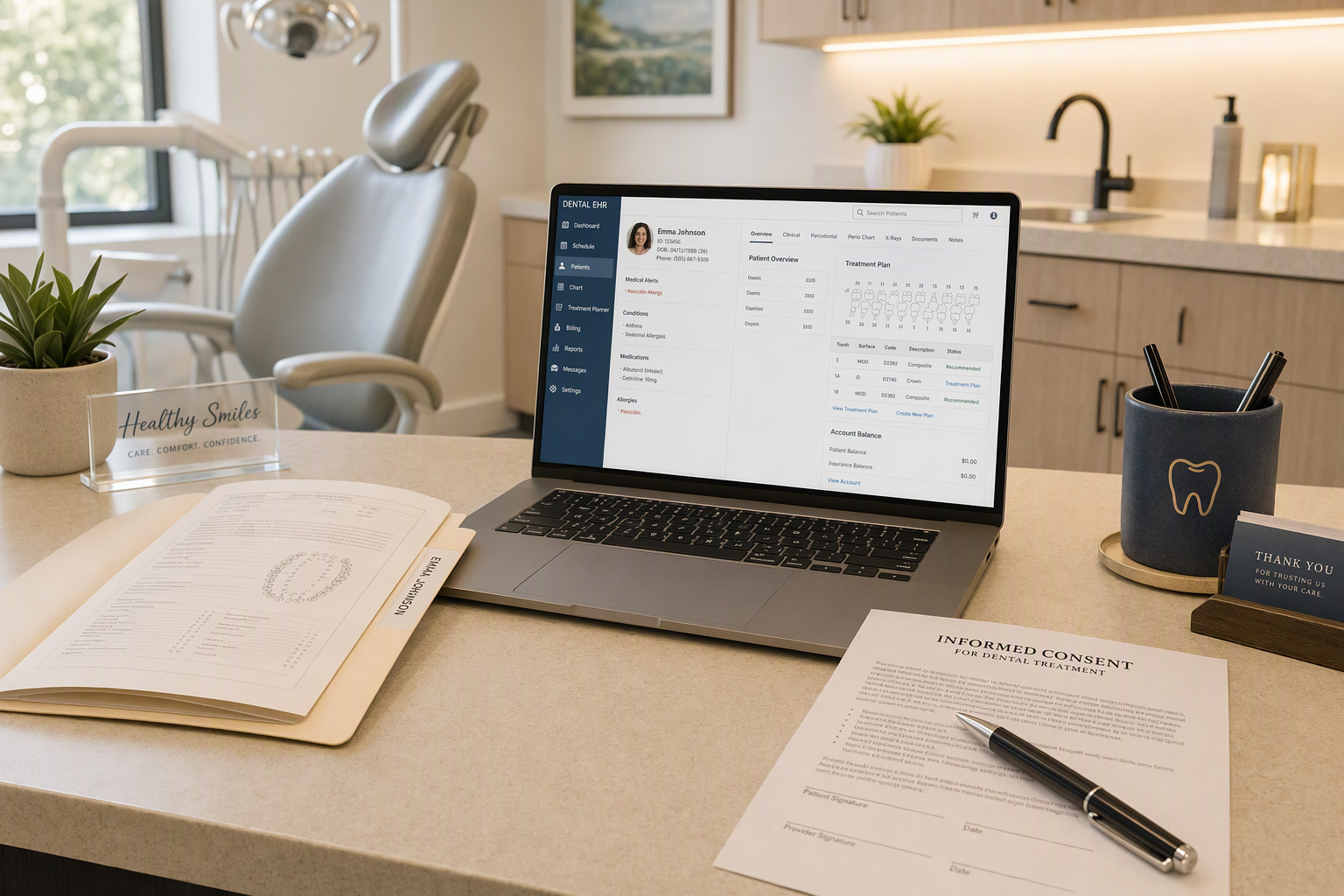
A patient leaves the chair satisfied. Six months later, a letter arrives from a lawyer. The treatment was fine — but the record is thin, the consent note is missing, and the only entry for that appointment reads "composite, 36, OK." At that point, the documentation is not a formality. It is the entire case.
01The Core StandardWhat Every Entry Must Answer
Good clinical documentation answers four questions for every appointment: What did you find? What did you decide? What did you do? What did you tell the patient? If any of those four are missing, the record has a gap — and gaps are where disputes live.
The baseline that holds across jurisdictions — from EU member states to the US, Australia, and the UK — is built on the same principles. Entries must be contemporaneous (written at the time of care, not reconstructed days later), legible, attributable (signed or authenticated), and complete enough that a colleague picking up the chart cold could continue care without calling you. The WHO and ISO standards for health records, as well as national dental council guidelines in most countries, converge on this framework.
What counts as "enough"? A working rule: document anything that influenced a clinical decision. Chief complaint, relevant medical history updates, examination findings, diagnosis, the treatment plan you discussed, what you actually did (materials, tooth numbers, techniques), the patient's response, and next steps. That is not excessive — that is the minimum.
02Informed ConsentThe Most Litigated Gap in Dental Records
Consent is not a signature on a form. The form is evidence that a conversation happened. The record must show what was discussed: the proposed treatment, the realistic alternatives (including no treatment), the material risks, and the patient's questions and responses. A signed form with no supporting note is weak. A detailed note with no signature is better than nothing but still incomplete. Both together are defensible.
For complex or high-risk procedures — implants, extractions of impacted teeth, orthodontic treatment, any procedure with a meaningful complication rate — the consent note should be specific. "Risks discussed" is not a note. "Patient informed of risk of inferior alveolar nerve proximity, temporary or permanent altered sensation; patient acknowledged and consented to proceed" is a note.
03Emails, SMS, and Messaging AppsWhat Goes Into the Record
This is where most practices are behind. The short answer: any clinical communication belongs in the record. If a patient sends a photo of a swollen face by WhatsApp at 10 pm and you advise them to go to A&E, that exchange is a clinical event. Screenshot it, attach it to the chart, and add a brief note summarizing your advice and the time it was given.
The same applies to emails about treatment planning, post-operative instructions sent by text, or a phone call where a patient declines a referral. The medium does not matter — the clinical content does. What you are protecting against is a scenario where the patient later claims they were never told something, and the only record of that conversation lives in a messaging app you no longer have access to.
A practical system: at the end of each day (or immediately after any out-of-hours contact), copy or summarize all clinical communications into the EHR. Most modern practice management systems allow file attachments. Use them.
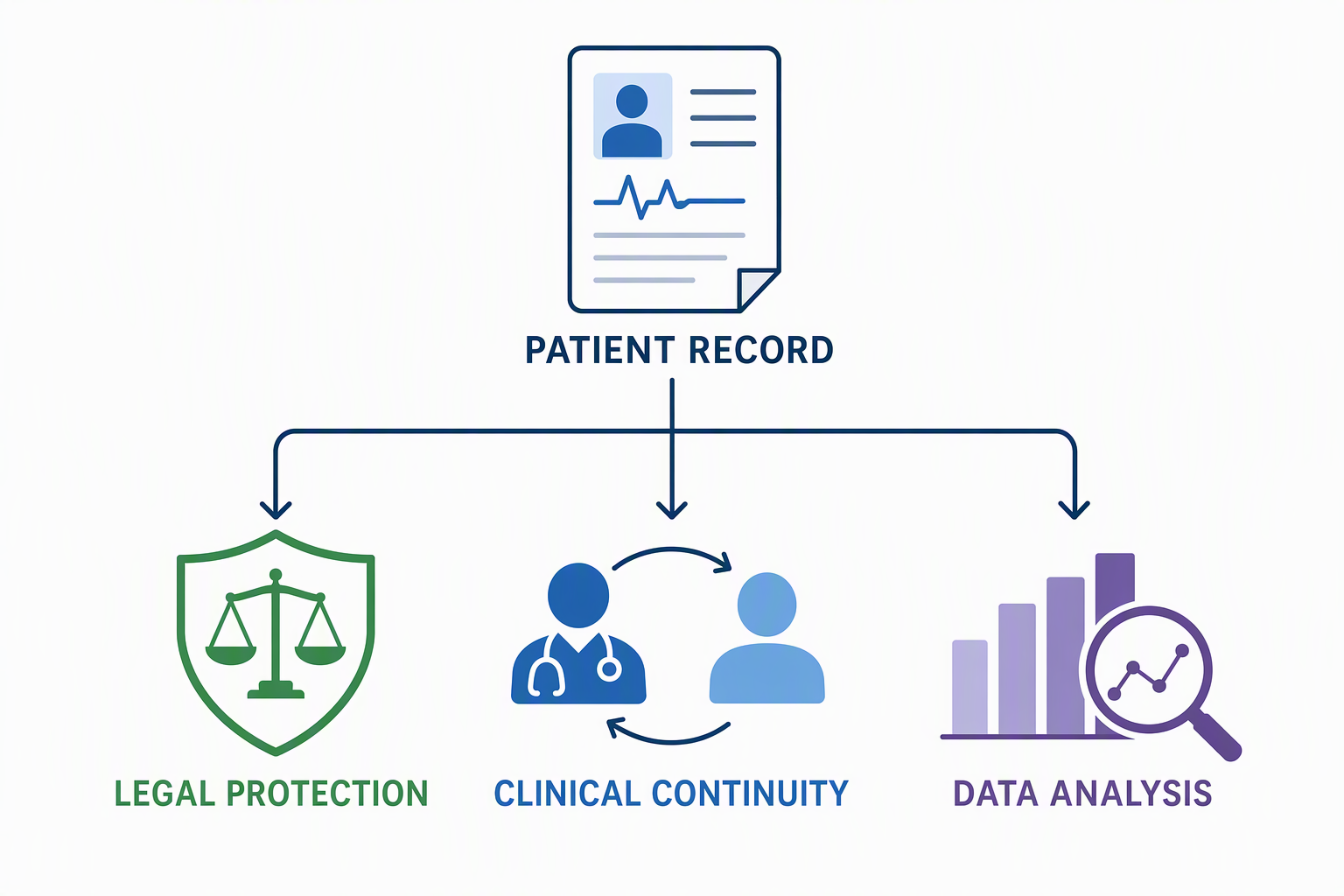
Structured, standardized diagnostic entries in electronic health records enable aggregation and secondary analysis of clinical data — supporting quality improvement and epidemiological assessment at scale.
Kalenderian E et al. · Journal of Public Health Dentistry, 2016
04Too Much vs. Too LittleFinding the Right Density
There is a real risk of over-documentation — entries so long and defensive that they obscure the clinical picture and take longer to write than the appointment itself. The goal is not a legal brief. It is a clinical record.
A useful test: would a competent colleague reading this note understand what happened and why? If yes, it is probably enough. If the note is three paragraphs of defensive language and no actual clinical findings, it is too much of the wrong thing.
What to always include:
- Updated medical history flag (even if unchanged — note that it was reviewed)
- Tooth/site, procedure, materials used (including batch numbers for implants or bone grafts)
- Anaesthetic type, dose, and patient response
- Any deviation from the planned treatment and the reason
- Post-operative instructions given (and how — verbal, written, digital)
- Follow-up plan
What you can omit:
- Routine procedural steps that are standard of care and not individualized
- Defensive commentary that is not clinically relevant ("patient seemed satisfied")
- Duplicate information already captured in structured EHR fields
05Documentation as a Data AssetThe Part Most Practices Ignore
The record is not just a legal shield. It is the only systematic dataset you have about your own clinical outcomes. Practices that use structured EHR entries — standardized diagnostic codes, consistent material logging, documented follow-up findings — can answer questions that unstructured notes cannot: What is my implant survival rate at 3 years? How often do my composites on second molars need replacement? Which patients are non-compliant with recall and what do their periodontal outcomes look like?
Research from dental school networks using shared EHR repositories has shown that structured diagnostic terminology allows cross-institutional outcome analysis that would be impossible with free-text notes alone. The same principle applies at the practice level. If you log every restoration with tooth, surface, material, and date, you can audit your own work in five years. If you write "filled 36," you cannot.
06The Standard That Holds EverywhereA Practical Checklist
No matter where you practice, the following documentation habits are defensible under any national framework and align with international standards (ISO 13606, HL7 FHIR, and the documentation principles embedded in GDPR and HIPAA alike):
- Date and time on every entry, authenticated by the treating clinician
- Medical history reviewed and updated at every appointment — even if unchanged
- Consent documented with specifics, not just a checkbox
- Clinical findings recorded before treatment, not inferred from it
- Treatment rendered with materials, tooth references, and any intraoperative decisions
- Patient communication — including digital — summarized in the chart
- Follow-up plan stated explicitly, not assumed
The record does not need to be long. It needs to be complete. Those are different things — and the difference is what separates a practice that learns from its own data from one that is simply hoping nothing goes wrong.

👨⚕️ doc. MUDr. Radek Mounajjed DDS., PhD. 🦷 D.C.M. Clinic 🎓 Associate Professor, Palacký University Olomouc, Czech Republic 📚 CICERO Cofounder ⚖️ Certified Court Expert in Dentistry
View educator profile