
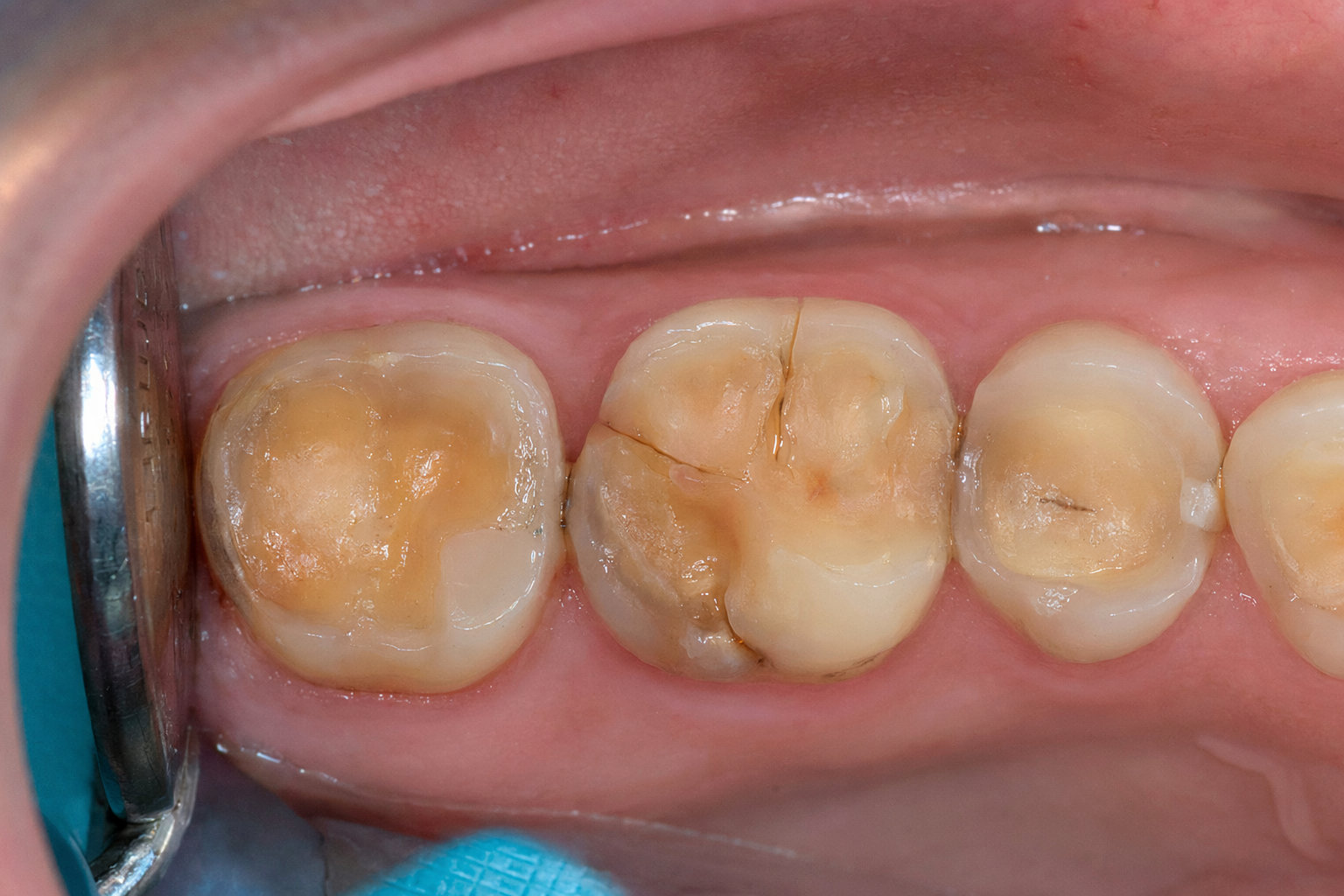
A patient presents with a fractured crown six months after cementation. Or with a fracture of a non-vital tooth that went uncrowned for a year. Or with their third restoration in the same site over five years. Every time, the same question: could this have been prevented?
01A Risk You Cannot Claim BackWhy High Occlusal Force Changes the Rules
Excessive occlusal force is a silent destructor. It causes no pain, shows nothing on radiographs, and the patient is usually unaware of it — until something breaks. Yet it is one of the most powerful mechanical stressors that dental tissue and prosthetic restorations face. Bruxism can generate forces many times higher than physiological mastication, repeatedly, at night, and beyond conscious control.
The key legal and ethical dimension: a prosthetic restoration that fails due to excessive bite force has failed outside the clinician's direct control. It cannot be claimed as a manufacturing defect. However, if the dentist identified the risk, failed to document it, and took no preventive measures — the liability shifts accordingly.
02Prevention FirstWhat to Address Before Prosthodontic Treatment Begins
A nocturnal occlusal splint is not merely an accessory — it is a fundamental protective measure for every patient with confirmed or suspected bruxism. The same applies to regular assessment of canine guidance: if it is compromised, lateral forces are transferred to the posterior teeth in ways they are not designed to withstand.
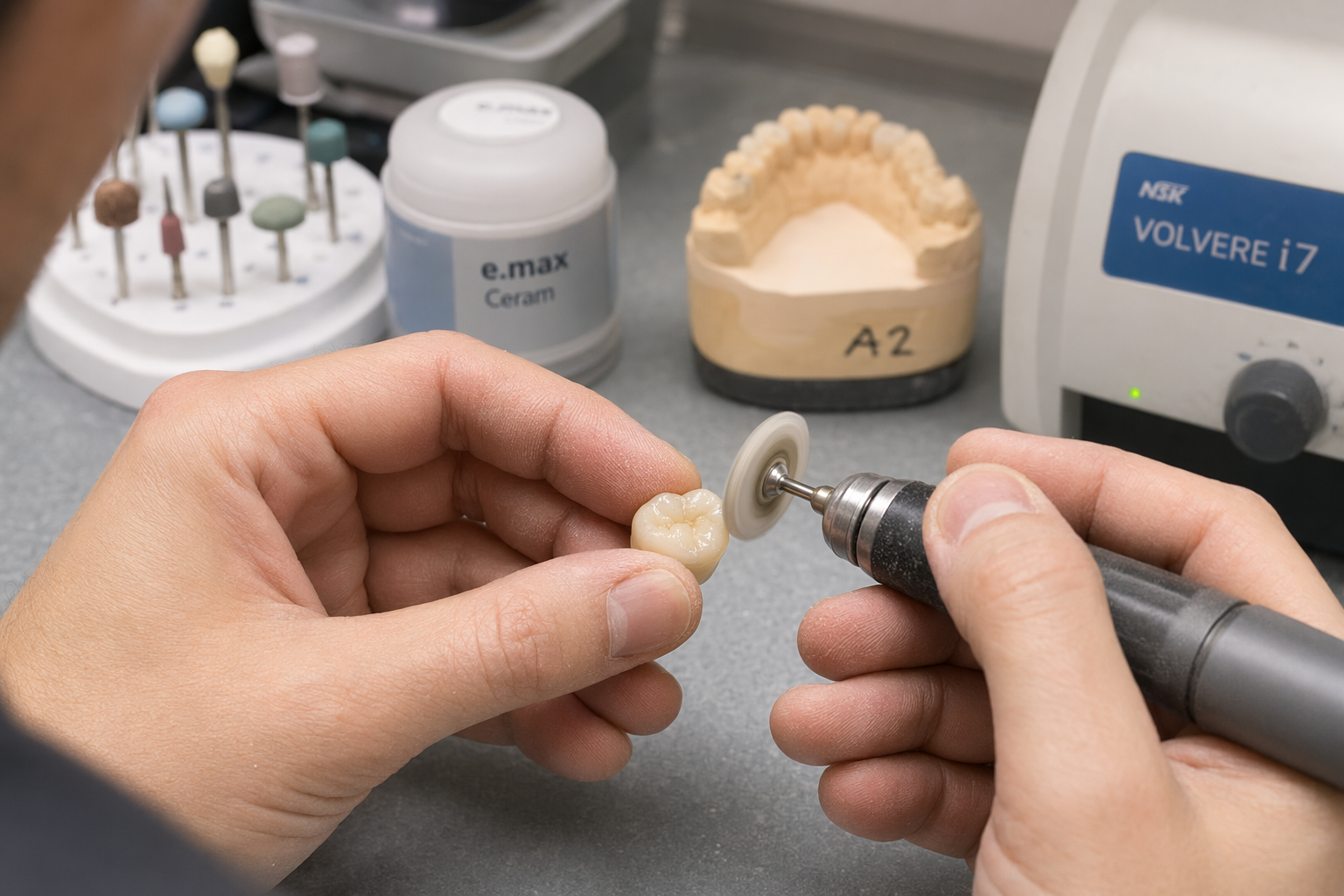
Ceramic occlusal contacts must be smooth. A rough ceramic surface causes abrasive wear of opposing teeth faster than natural enamel — even at physiological occlusal force levels. Every prosthetic unit fabricated should undergo final polishing of all contact surfaces. Unpolished ceramic in occlusal contacts carries a higher risk of fracture.
03Restorative DentistryWhen Composite Is Not Enough on Its Own
In patients with high occlusal force, composite restorations in the posterior segment behave differently than in the general population. Combining conventional composite with a fiber-reinforced composite as a base layer increases the overall system's fracture resistance — the fibers absorb a portion of the flexural stress that would otherwise lead to restoration or tooth fracture.
After endodontic treatment, one rule applies without exception: crown placement as soon as possible. A non-vital tooth without a crown is a ticking time bomb in a patient with excessive bite force. If the tooth also lacks adequate bone support, extraction and implant replacement is more predictable than pointlessly trying to save the tooth at all costs. Your patient has an extreme bite.
04Prosthodontics for High Occlusal LoadMaterials and Geometry That Matter
Layered ceramics in bruxism patients fail predictably — the veneer layer chips under cyclic loading. Monolithic crowns, particularly those made from yttria-stabilized zirconia with 3–4 % yttria content, offer significantly better fracture resistance while maintaining aesthetics.
Restoration geometry matters as much as material selection. Large bridges carry elevated risk under high occlusal load — the ideal is a maximum of one pontic with a robust connector. Cementation with a composite resin cement (e.g. Panavia V5) provides adhesive retention that withstands higher occlusal forces better than conventional cements.
Occlusal relief of implant-supported crowns by at least 40 μm in maximum intercuspation is not merely a recommendation — it compensates for the absence of the periodontal ligament, which in natural teeth acts as a shock absorber for impact forces.
Clinical Practice, Cicero Education
Veneers and minimally invasive preparations (under 1 mm) are contraindicated in high-force occlusion unless the concept of protected occlusion is strictly observed. Broad occlusal contacts in place of sharp cusps distribute force over a larger area — reducing the risk of stress concentration at a single point.
05ConclusionMeasuring Bite Force as Part of Every Treatment Plan
Measuring and documenting occlusal force before commencing treatment is not an optional extra — it is part of sound clinical practice for every patient in whom more extensive reconstruction is planned. Risk can be managed. But it cannot be managed if it goes unseen.

🌍 Cicero System🎓 Dental Education | 🛒 Procurement | 🏥 Clinic Management