
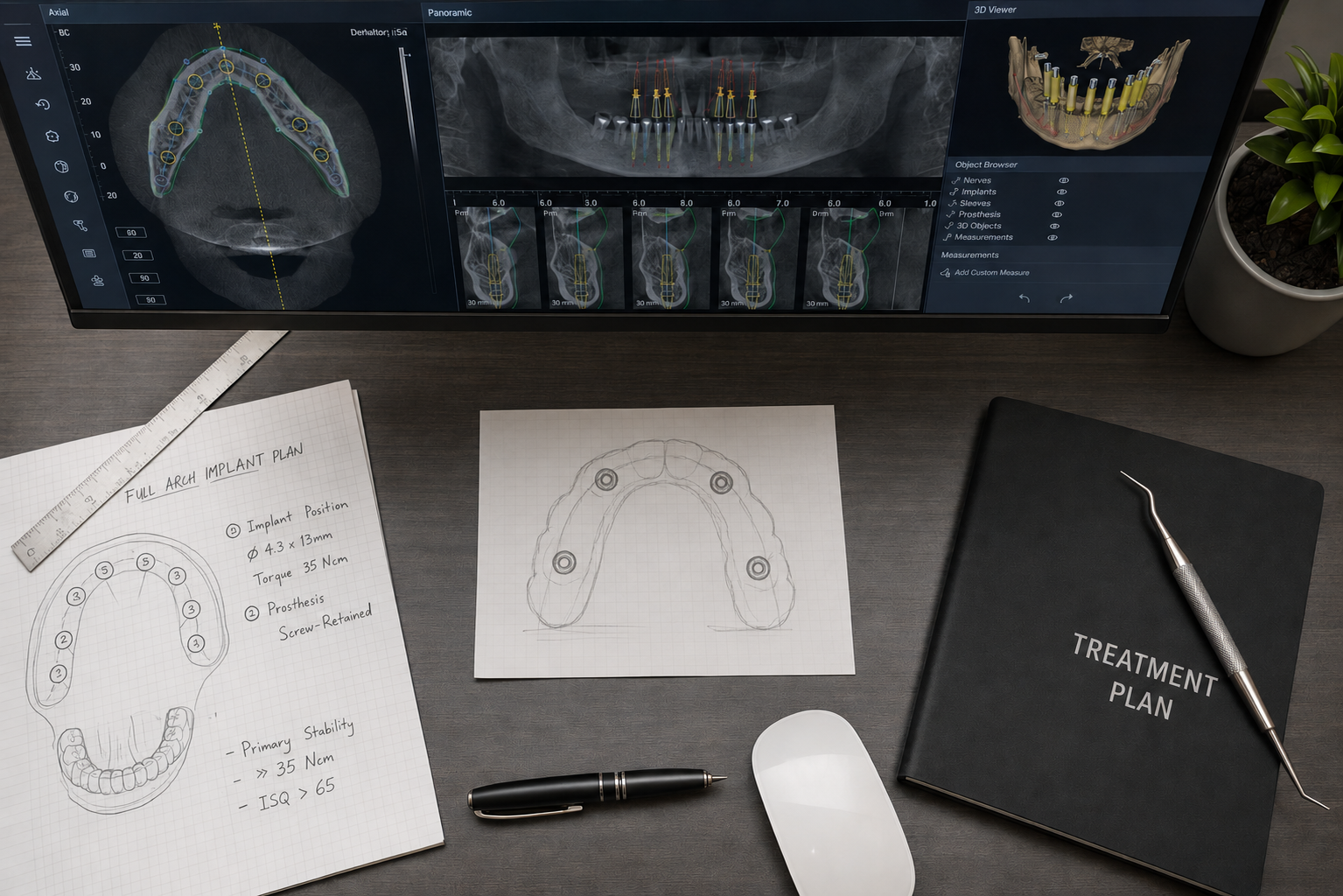
The term "All-on-4" was never meant to be a ceiling. Paulo Maló's original concept was a floor — a minimum viable solution for the severely atrophic jaw that made full-arch rehabilitation accessible without bone grafting. Somewhere along the way, the number became negotiable, and "All-on-X" entered the lexicon. That flexibility is clinically legitimate. The question is what drives the X.
01The Core QuestionIs the Extra Implant for the Patient or for the Clinician?
When a treatment plan calls for six implants instead of four, there should be a clear, patient-centred reason. Bone volume that cannot support a distal tilt. A parafunctional patient with documented bruxism. An arch span that genuinely demands additional support. These are valid indications — and the biomechanical literature supports them in specific anatomical contexts.
What is not a valid indication is uncertainty about the original plan. Adding implants to hedge against a placement that felt suboptimal, to compensate for a cantilever that ended up longer than intended, or to cover for inadequate pre-surgical planning is a different clinical act entirely. The implant count goes up; the underlying problem does not go away.
02What the Biomechanics Actually ShowEqual Span, Equal Load on the Terminal Implants
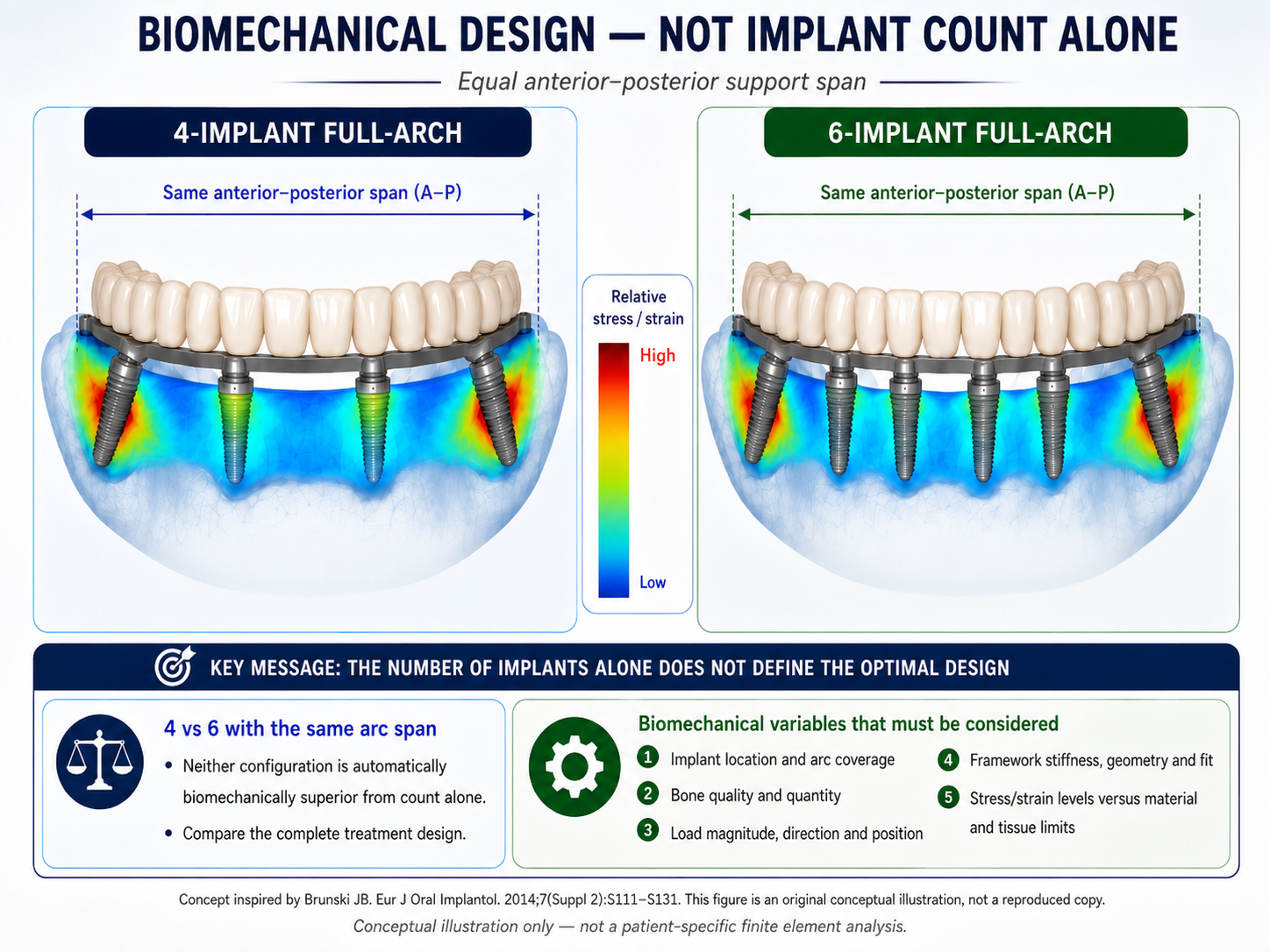
Finite element analysis studies comparing four- and six-implant full-arch configurations consistently show that when the anterior-posterior span is held equal, the tensile and compressive axial loads on the most medial and distal implants do not differ meaningfully between the two configurations. The intermediate implants in a six-implant design absorb a share of the mid-arch load — but the terminal fixtures, which carry the highest mechanical demand in any full-arch prosthesis, experience comparable stress regardless of how many implants sit between them.
This is not an argument against six implants. It is an argument against the assumption that adding implants automatically protects the most loaded positions. A 2025 FEA scoping review in the British Dental Journal confirmed that higher stress around distal implants is a consistent finding across study designs, and that implant number alone does not resolve it — positioning and span do.
03What Actually Moves the NeedlePlanning Variables That Matter More Than Count
The variables that most reliably influence biomechanical outcomes in full-arch rehabilitation are not the number of implants — they are the anterior-posterior spread, cantilever length, implant angulation, and framework material. A well-planned All-on-4 with a controlled cantilever and optimal tilt outperforms a poorly planned All-on-6 with excessive distal extension every time.
Cantilever length is the most consequential modifiable factor. FEA data show that cantilever extensions beyond 9–12 mm produce stress concentrations that no additional mid-arch implant can neutralise, because the lever arm acts on the terminal fixture regardless of what sits anterior to it. Framework material matters too: PEEK frameworks distribute bone stress more favourably than titanium at short cantilever lengths, while titanium becomes preferable as extension increases.
Arch morphology is another variable that implant count cannot override. V-shaped and U-shaped mandibles behave differently under molar loading — and in V-arch anatomy, the biomechanical benefit of a fifth implant is substantially greater than in a square arch. Planning that ignores arch morphology and defaults to a fixed number is planning by template, not by patient.
04The Standard That Should Drive the DecisionPatient-Centred Indication, Not Clinician Comfort
The 2025 Global Consensus for Clinical Guidelines on edentulous maxilla rehabilitation — developed through structured expert consensus and systematic review — frames implant number as a patient-centred decision, not a protocol default. The recommendation is individualised planning based on bone volume, arch morphology, functional load, and patient-reported factors. There is no universal correct number.
That framing matters because it shifts the burden of justification. The question is not "why only four?" — it is "what does this patient's anatomy, function, and risk profile require?" When the answer is six, place six. When the answer is four, placing six does not make the case stronger. It makes the surgery longer, the cost higher, and the recovery harder — without changing the biomechanical reality at the positions that matter most.
Implant number, placement timing, and loading protocols should be guided by individualised, patient-centred care.
Global Consensus for Clinical Guidelines, Implant Dentistry · 2025
05The TakeawayPlan First, Count Second
All-on-X is a useful concept when X is derived from the patient. It becomes a liability when X is derived from the clinician's confidence level. The biomechanics do not reward implant count for its own sake — they reward span control, cantilever discipline, and anatomically informed positioning.
Plan the prosthesis first. Let the prosthesis define the implant positions. Let the positions define the number. That sequence produces an X that means something.

DDS: Universidad Javeriana, Bogota - Colombia; Prosthodontics: University of Rochester Eastman Dental Center, Rochester, NY; Private Practice, Scottsdale, AZ; Diplomate, American Board of Prosthodontists; Fellow, American College of Prosthodontists; Associate Fellow, Academy of Prosthodontics
View educator profile