
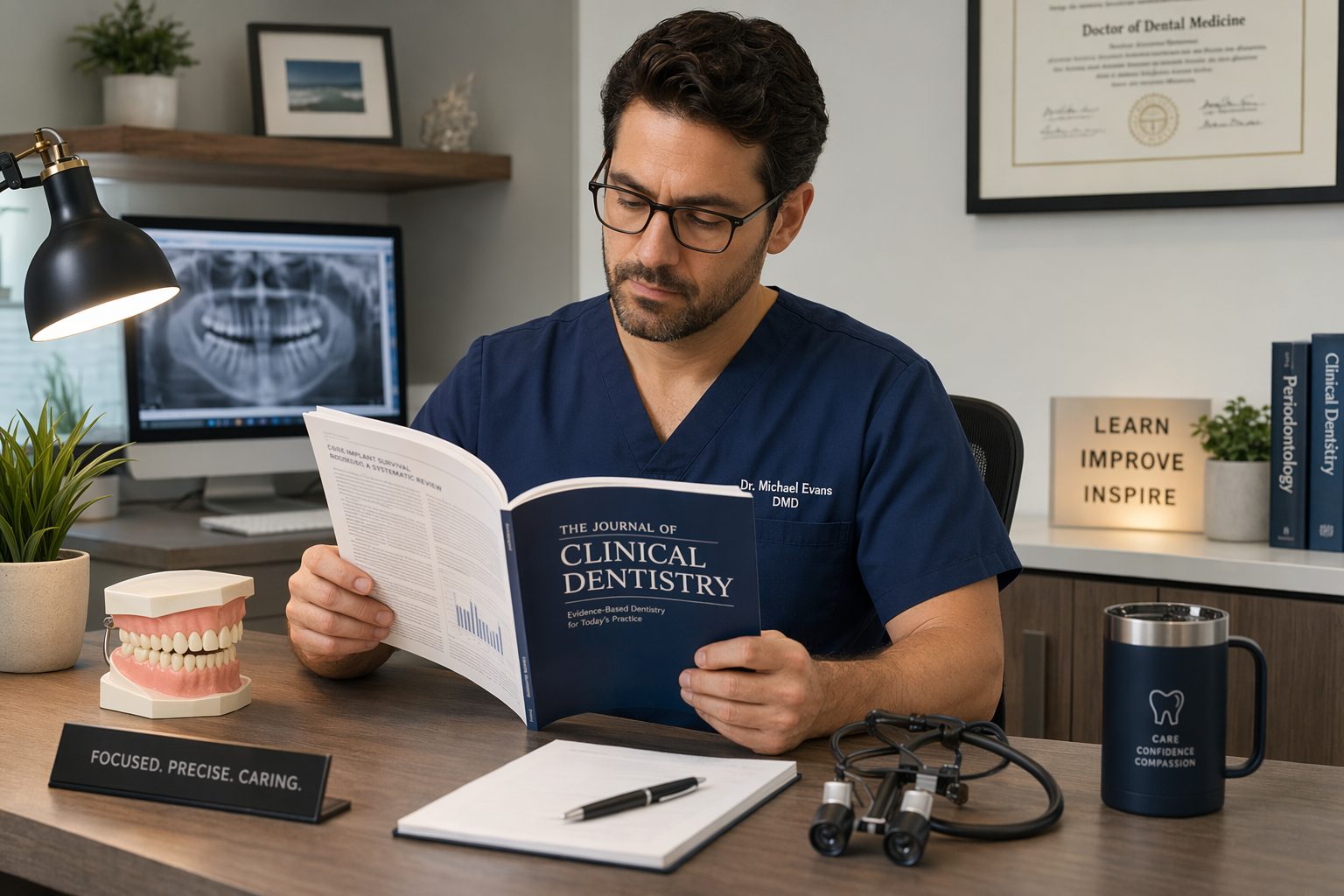
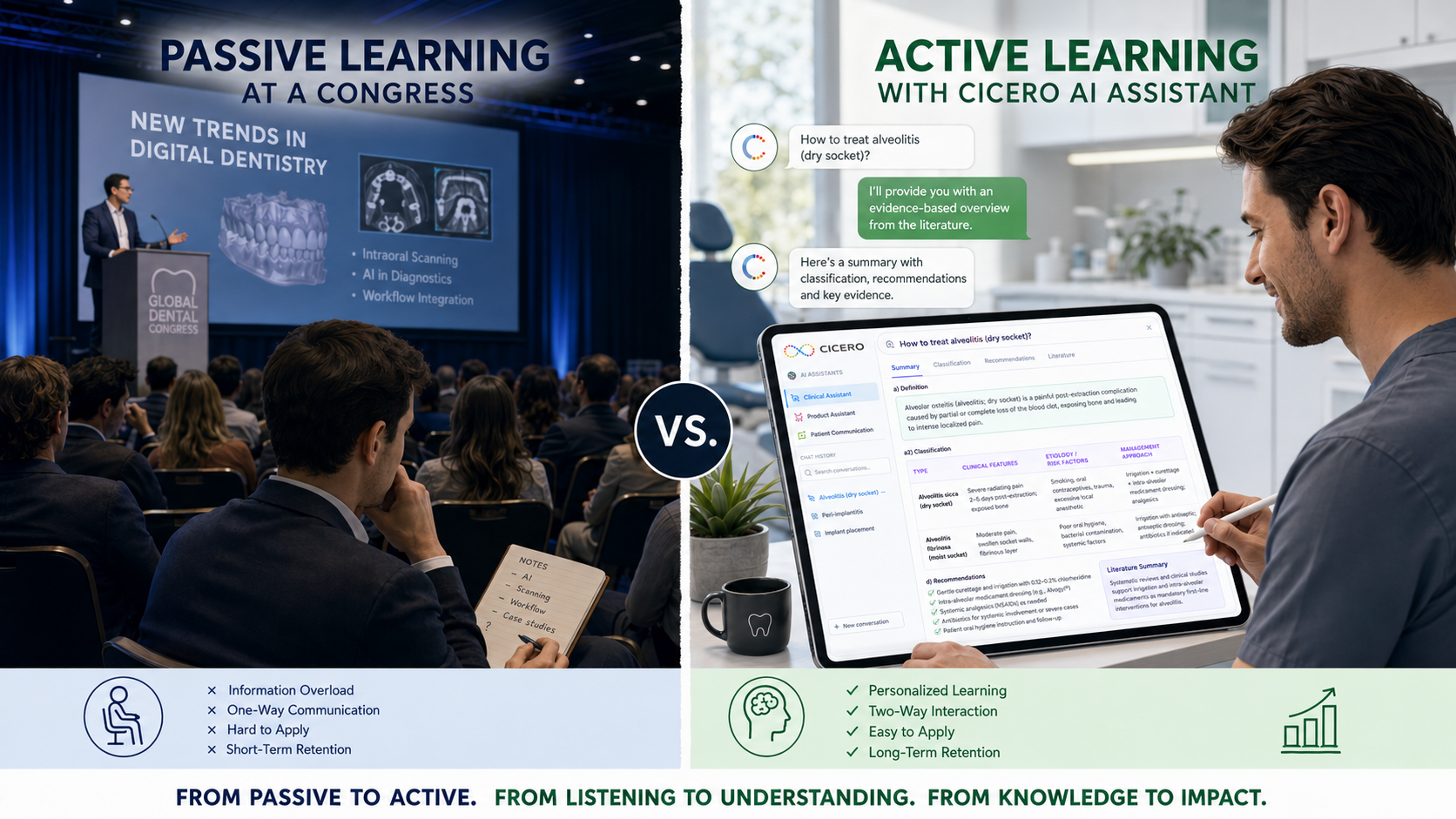
A dentist walks out of a two-day congress in May, notebook full, head buzzing. By August, most of what was absorbed has faded. By the following May, the cycle repeats. The certificate gets renewed. The knowledge gap quietly widens.
01The ProblemWhy a Congress Alone Falls Short
Continuing professional development in dentistry is often measured in hours logged and certificates collected. That metric captures attendance — it says nothing about retention, application, or clinical growth. A congress is a snapshot: two intense days of information delivered to a passive audience, followed by eleven months of clinical routine that slowly erodes what was learned.
The research on knowledge retention is unambiguous. Without active recall and spaced repetition, the majority of new information is lost within days. A single annual event — however excellent the speakers — cannot compensate for the compounding effect of daily clinical questions left unanswered.
02The LiteratureWhat We Know About Active Learning
The dental profession generates an enormous volume of new evidence every year — updated protocols, revised material classifications, emerging techniques in implantology, endodontics, and restorative dentistry. Keeping pace requires more than attendance; it requires active engagement with the literature.
Active learning — asking a specific question, reading a targeted answer, and applying it the next day — produces durable knowledge. Passive attendance at lectures does not. This is not a controversial claim; it is the foundation of every modern medical education framework. The challenge is that reading primary literature is genuinely hard. Extracting the clinically relevant signal from a dense systematic review takes time and expertise that most practitioners simply do not have between patients.
This is precisely the gap that a well-designed AI learning tool can close — not by replacing the literature, but by making it accessible in the clinical moment.
03The Cicero AI ApproachA Teacher, Not a Search Engine
The Cicero AI Assistant is built around a specific premise: a dentist who asks two focused clinical questions per week, reads the answer carefully, and follows up with a clarifying question, will accumulate more durable, applicable knowledge in six months than a colleague who attends four congresses per year.
The difference is not intelligence or effort. It is frequency and active engagement. The AI acts as a teacher and advisor — it does not return a list of links. It synthesises, contextualises, and explains. A question about the current evidence on immediate implant placement in the aesthetic zone returns a structured answer that a clinician can act on tomorrow morning, not a 47-page PDF to read on the weekend.
Two questions a week, answered properly, is more than most dentists get from their entire annual CPD budget.
Cicero System · Clinical Education Team
04The Competitive EdgeWhat Separates Good Clinicians from Great Ones
Competition among dental practitioners is real and intensifying. Patients are better informed, more discerning, and more willing to seek a second opinion. In this environment, the clinician who wins is not necessarily the one with the most expensive equipment — it is the one who combines technical precision with clinical knowledge, empathy, and the ability to explain a treatment plan clearly.
Knowledge reduces error. A dentist who understands the current evidence on adhesive protocols makes fewer bonding failures. One who stays current on periodontal classification makes fewer missed diagnoses. These are not abstract improvements — patients notice them, even when they cannot name them. They notice that the treatment worked, that the explanation made sense, that the follow-up was appropriate.
05The HabitHow to Build It
The barrier to daily learning is not access — it is habit formation. The Cicero AI Assistant works best when it becomes part of a routine: a question after a challenging case, a clarification before a procedure you haven't done in a while, a quick review of a material you're considering switching to.
Two sessions per week is a realistic and effective cadence. That is roughly eight focused learning interactions per month, forty per quarter. Within a few months, the cumulative effect becomes visible — not just in knowledge scores, but in clinical confidence, in the speed of decision-making, and in the quality of conversations with patients.
The dentist who builds this habit does not need to be the most naturally gifted in the room. Consistency, curiosity, and the right tool are enough.
👨⚕️ doc. MUDr. Radek Mounajjed DDS., PhD. 🦷 D.C.M. Clinic 🎓 Associate Professor, Palacký University Olomouc, Czech Republic 📚 CICERO Cofounder ⚖️ Certified Court Expert in Dentistry
View educator profile