
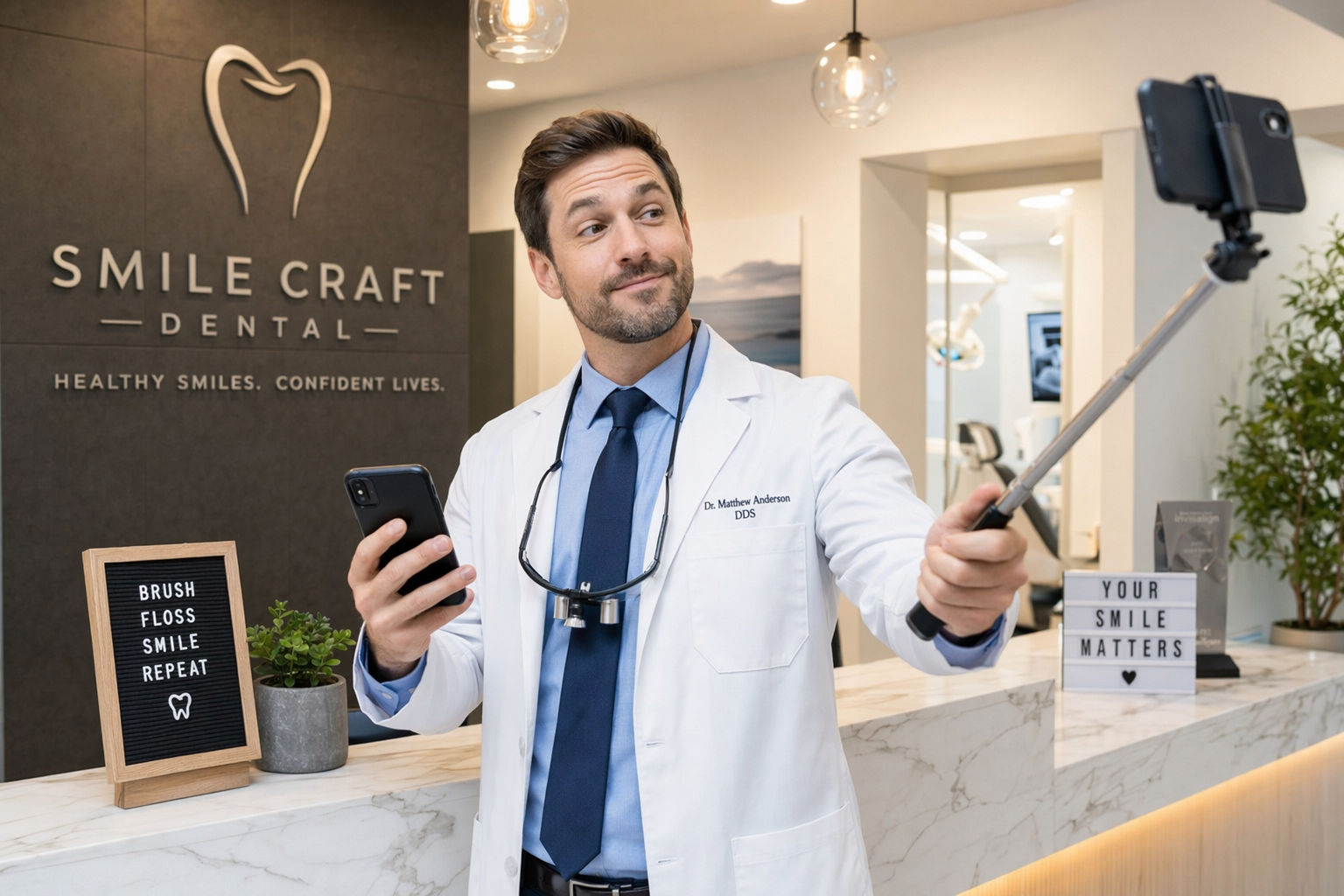
Twenty years ago, marketing a dental practice was simple: a gold plaque by the entrance, a listing in the phone book, and a good reputation passed from neighbour to neighbour. Today you can choose between Instagram, Google Ads, loyalty programmes, and — if you're in the US — a prime-time ad spot. The world has split into two camps, and the gap between them is wider than the chasm between amalgam and a full-zirconia crown.
01Old EuropeSilence, Please. People Are Being Treated Here.
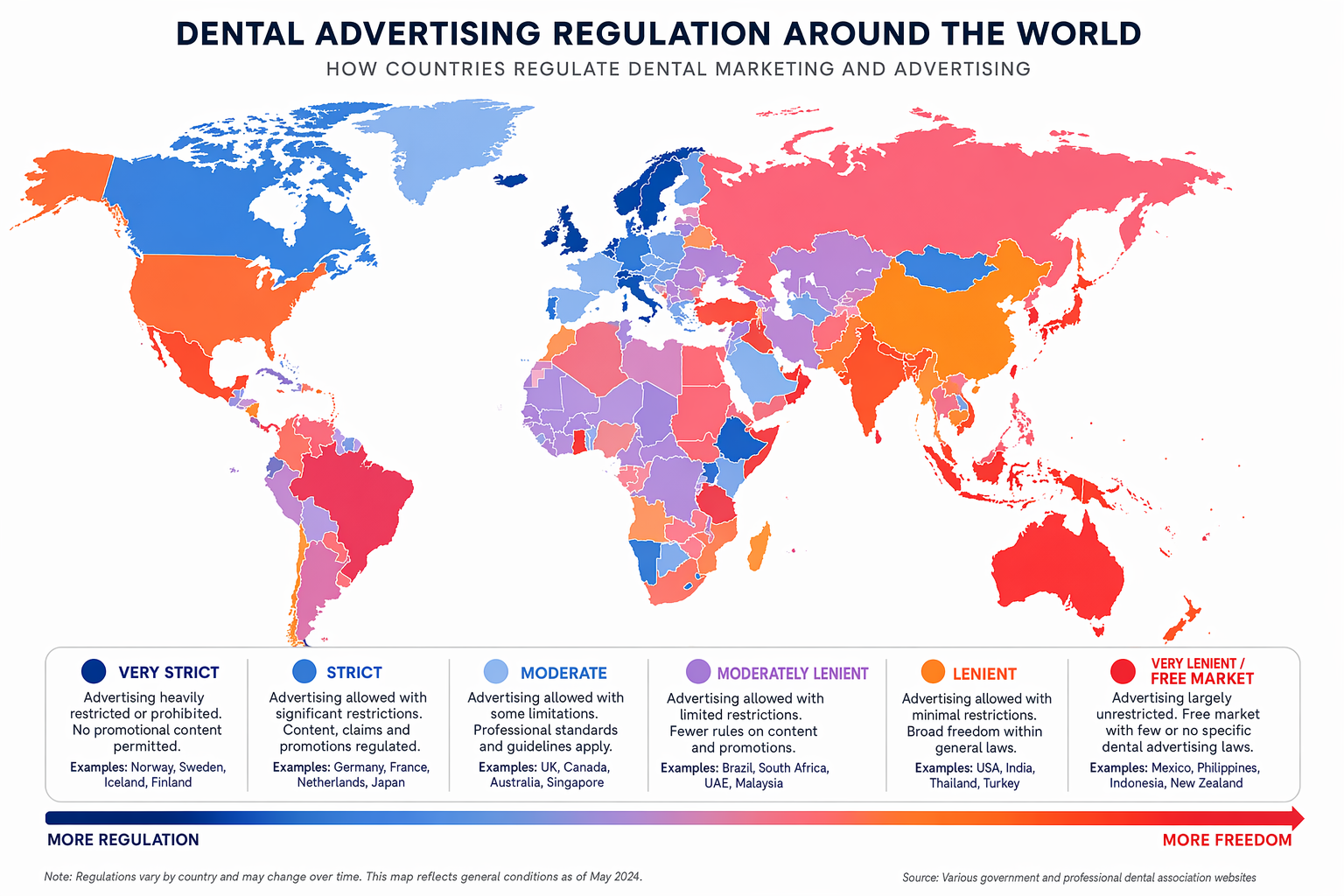
In Europe, the atmosphere around dental marketing is roughly the same as in a waiting room before a root canal — tense, quiet, and full of unspoken rules. The Czech Republic, Germany, France, and Sweden all have codes of ethics that place significant restrictions on healthcare advertising. The Czech Dental Chamber, for example, is clear that advertising must not be misleading, must not promise results that cannot be guaranteed, and must certainly not compare one practice to a competitor in the style of "we're better than the dentist around the corner."
The result? European practice websites look like the annual reports of a mid-sized insurance company. Professional, trustworthy, and with roughly the same level of excitement. A photo of the reception, a list of treatments, contact details. Done. No "OFFER: fillings at half price until the end of the month." No before/after photos with dramatic lighting. Just quiet dignity and the conviction that a good dentist doesn't need to sell themselves — patients will find them on their own.
02North AmericaA Perfect Smile for 0% Interest Over 24 Months
Across the Atlantic, it's a different sport entirely. In the United States, dental marketing is a fully-fledged industry with its own agencies, consultants, podcasts, and conferences. Direct-to-consumer advertising spending on health services in the US grew from $542 million in 1997 to $2.9 billion in 2016 — and dental centres were among the fastest-growing categories. Billboards promising "a perfect smile in one day", television spots for orthodontic chains, and Facebook campaigns offering a free first consultation are completely normal features of the landscape.
The American Dental Association (ADA) does have a code of ethics, but it is considerably more permissive than European regulations. The key rule is: advertising must not be misleading. What does that mean in practice? If your billboard says "The Most Beautiful Smiles in Arizona" — that's just an opinion, not deception. If it says "We Guarantee Results in 48 Hours" and you fail to deliver, only then do you have a problem. The space for creativity is therefore... generous.
In Australia, more than 85% of dental practice websites were found to be in breach of at least one statutory advertising requirement — most commonly due to misleading information or unrealistic promises of results.
Výzkum Jensen et al., Australian Dental Journal, 2023
03The Rest of the WorldFrom Fatwas to TikTok
Jordan, India, Brazil — every country plays its own game. In Jordan, a dentist must obtain approval from the relevant chamber before launching any advertising campaign. Yet a 2025 survey found that 79% of Jordanian dentists consider advertising acceptable — and digital platforms are clearly the preferred channel. Attitudes are shifting along generational lines: younger dentists are far more open to marketing than their older colleagues.
In Brazil, the situation is interesting: the Federal Council of Dentistry (CFO) is among the strictest in the world. It bans not only comparative advertising, but also the publication of prices, and even the use of the word "best" in any context. A Brazilian dentist on Instagram can share educational content but cannot write "the best implants in São Paulo." Australia sits somewhere between Europe and the US — regulations exist and are fairly strict, but compliance, as research shows, is dismal.
04Where Is the LineWhat's Still OK and What's Already Absurd
There is an informal hierarchy of what makes dental marketing acceptable or absurd. At one end of the spectrum sit things nobody questions: a professional website with team photos, educational content on prevention, a Google profile with opening hours. That's fine everywhere — from Prague to Phoenix.
A little further along begins the grey zone: before/after photos (used cautiously in the EU, standard practice in the US), video testimonials from satisfied patients (banned in Australia, the norm in the US), discount promotions and loyalty programmes (ethically debated in the Czech Republic, entirely normal in the US). And then there's America in full bloom: dentists with their own merch (yes, a practice-branded T-shirt), reality shows about smile transformations, TikTok channels with millions of followers where the doctor in a white coat dances in front of an X-ray machine, and — the pinnacle of it all — dentists as celebrity endorsers of whitening products they would never actually recommend clinically.
Where is the line? Codes of ethics draw it differently, but one rule applies globally: advertising that creates unrealistic expectations or misleads a patient about treatment outcomes is a problem. Everywhere. Only the level of enforcement varies dramatically.
05A Conclusion Without a ConclusionSo What Do You Do With This?
Marketing a dental practice is not inherently unethical. It becomes unethical when it lies, promises the impossible, or manipulates vulnerable patients. A professional website, clear communication about services, educational content on social media — these are tools that help patients and build a practice. The problem arises when a surgery starts behaving like a used-car dealership.
European conservatism has its own logic: healthcare is not a commodity like any other, and excessive commercialisation genuinely threatens to erode trust in the profession. American openness has its logic too: an informed patient who knows what services exist and what they cost makes better decisions. The truth — as it tends to be — lies somewhere in the middle. Perhaps exactly where your well-designed, honest, and professional website stands. Without a dancing dentist. For now.

🌍 Cicero System🎓 Dental Education | 🛒 Procurement | 🏥 Clinic Management