
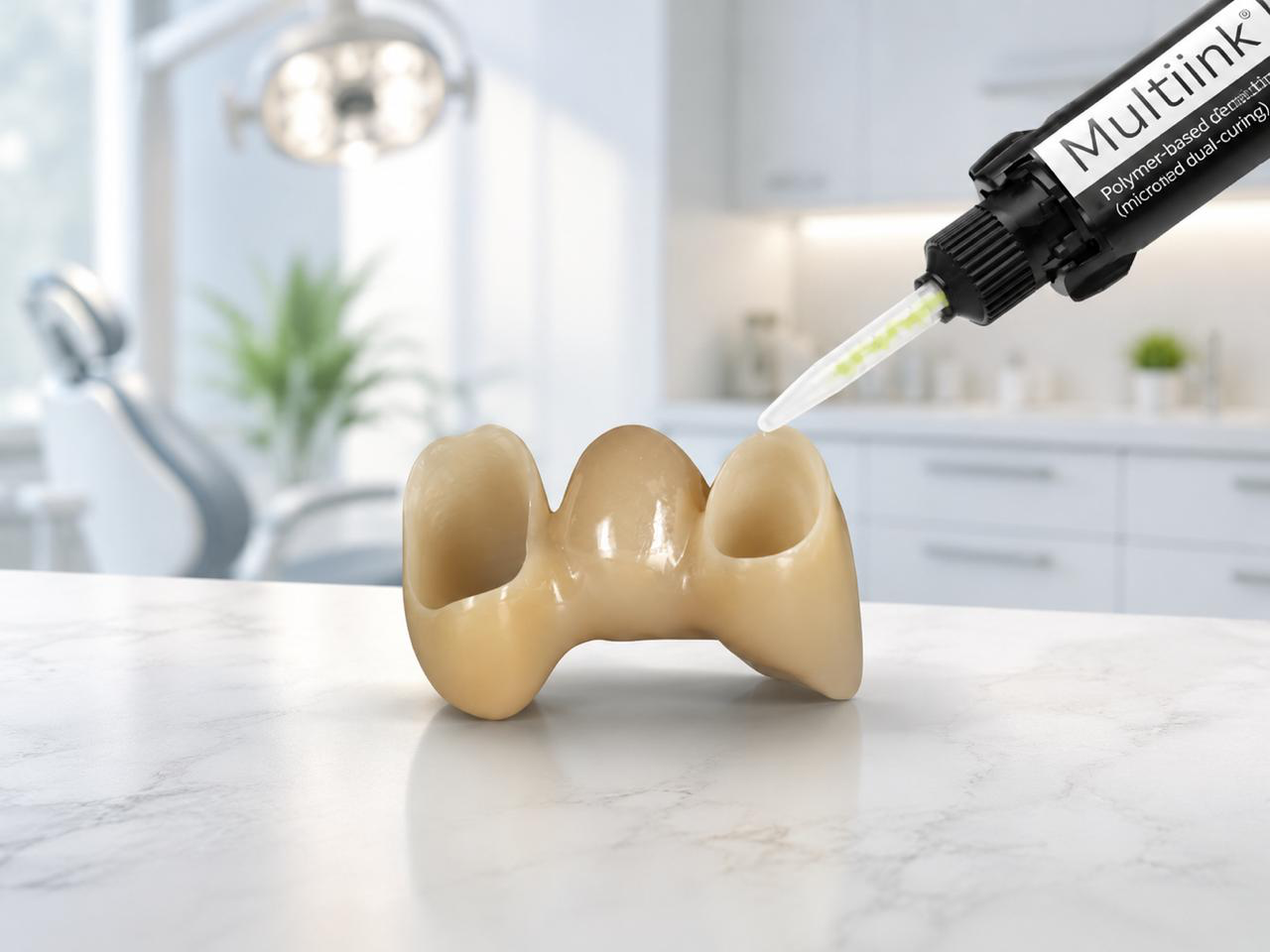
Choosing a cement is not an administrative decision — it is a clinical one. The wrong cement can ruin a precisely fabricated restoration before the patient even arrives for their first recall visit. Ivoclar offers a complete spectrum, from self-adhesive systems through dual-cure adhesive cements to purely light-cure variants for the most esthetically demanding indications. The functional common denominator of most of these systems is the monomer 10-MDP (10-methacryloyloxydecyl dihydrogen phosphate), whose ability to form stable calcium salts on the surface of hydroxyapatite and zirconia is among the best-documented mechanisms in adhesive dentistry.
01System OverviewFour Cements, Four Philosophies
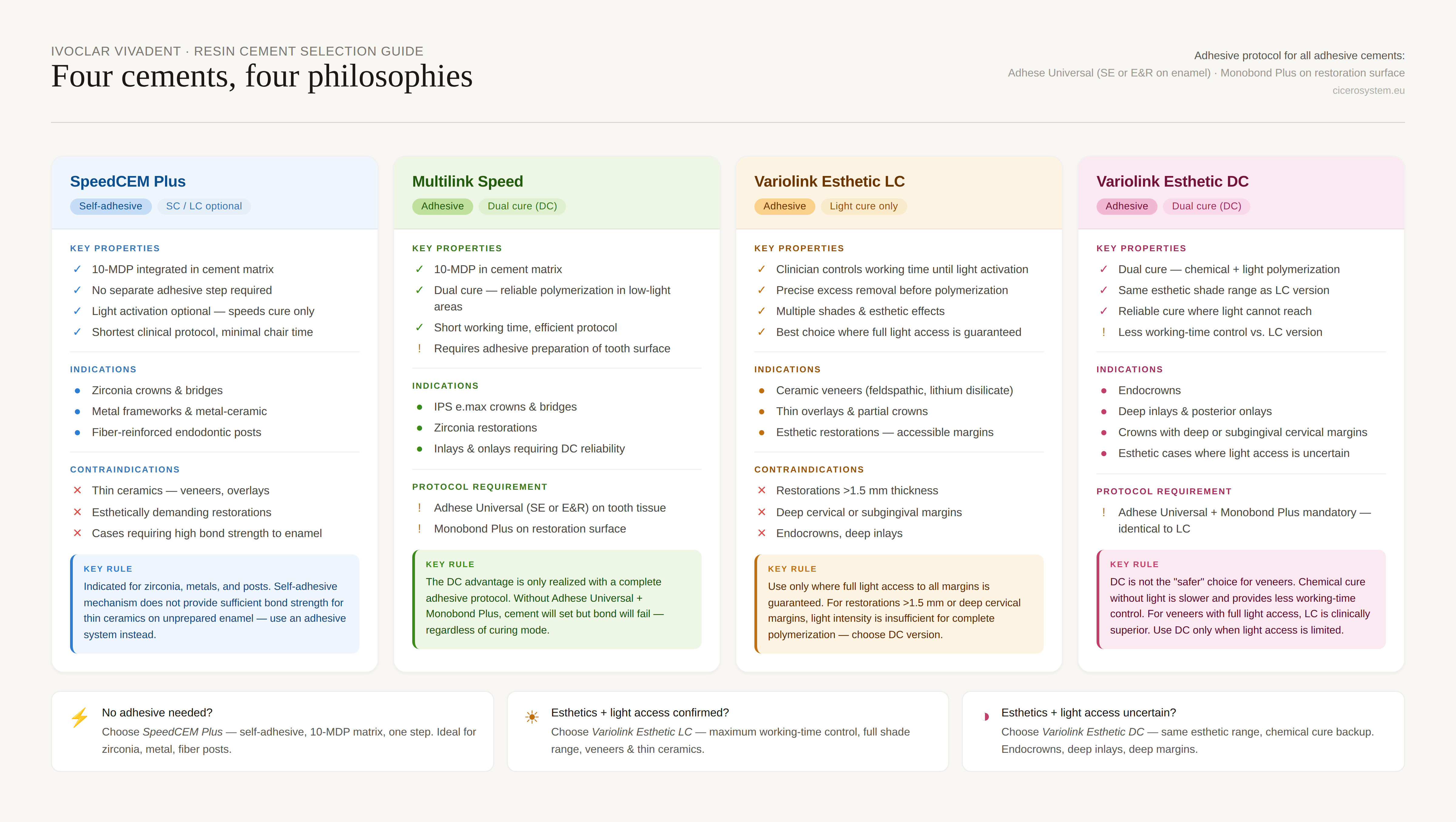
SpeedCEM Plus is a self-adhesive cement with a self-cure setting mechanism that requires no separate adhesive step — 10-MDP is integrated directly into the cement matrix. Light activation (LC) is optional and serves solely to accelerate setting in accessible areas; this is not dual-cure in the clinical sense — without light, the cement reliably cures chemically on its own. This makes it the first choice for situations where adhesive preparation of the tooth is neither necessary nor feasible: zirconia crowns and bridges, metal frameworks, glass-fiber endodontic posts. The key advantage is the simplicity of the protocol and the reduction in chair time. Contraindications include thin ceramic restorations (veneers, overlays), where the self-adhesive mechanism does not achieve bond strength comparable to an adhesive protocol, and situations where esthetics are the primary criterion — SpeedCEM Plus is available only in a limited range of shades.
Multilink Speed is an adhesive dual-cure cement (DC) containing 10-MDP, designed for a fast working time and reliable polymerization even in areas with limited light access. It requires adhesive preparation of the tooth — the recommended systems are Adhese Universal (in SE or E&R mode) on tooth tissue and Monobond Plus on the restoration surface. It is indicated for ceramic crowns and bridges in IPS e.max and zirconia, inlays, and onlays where the certainty of dual-cure is required. Without adhesive preparation of the tooth surface, the cement will not provide sufficient bonding to lithium-disilicate ceramic — this step cannot be skipped.
Variolink Esthetic LC is a purely light-cure cement intended for the most esthetically demanding indications: ceramic veneers, thin overlays, and partial crowns made of lithium-disilicate or feldspathic ceramic. Light-controlled setting gives the clinician control over the working time — the cement remains plastic until polymerization is initiated, which allows precise removal of excess. The prerequisite is perfect light access to all margins of the restoration; for restorations thicker than 1.5 mm or preparations with deep cervical margins, light may not reach sufficient intensity for complete polymerization. The adhesive protocol is mandatory: Adhese Universal in E&R mode on enamel, Monobond Plus on the ceramic surface.
Variolink Esthetic DC is the dual-cure version of the same esthetic line, intended for situations where light access cannot be guaranteed: endocrowns, deep inlays, crowns with a pronounced cervical margin, posterior onlays. It retains the esthetic properties of the LC version — availability in various shades and effects — and adds the certainty of chemical setting in areas the light cannot reach. The adhesive protocol is identical to the LC version and cannot be omitted.
02When to Avoid WhatThe Most Common Mistakes
Using SpeedCEM Plus under a thin veneer is one of the most common mistakes in everyday practice. Self-adhesive cements demonstrably have lower bond strength on enamel without prior etching and adhesive application than conventional adhesive systems — Hitz et al. (2012) [6] showed in a laboratory study with thermocycling that, after long-term aging, not all self-adhesive cements are a valid alternative to conventional resin cements for bonding glass-ceramic to dentin, with SpeedCEM being one of the tested systems. For a veneer 0.3–0.5 mm thick, where bonding to enamel is the primary retention mechanism, choosing a cement without a full adhesive protocol is a clinically risky decision.
Variolink Esthetic LC on an endocrown or deep preparation fails for a physical reason: curing light at the intensity needed for complete cure will not reach through more than 2 mm of ceramic and dentin to the depth of the preparation. The result is insufficiently polymerized cement with reduced mechanical properties and increased solubility — exactly what we do not want in an endodontically treated tooth.
Multilink Speed without adhesive preparation on a lithium-disilicate crown is a scenario that looks functional but is not. The cement cures, the restoration seats — and then, in 6–18 months, adhesive failure occurs at the cement–tooth interface, because without the hybrid layer created by the adhesive there is neither a micromechanical nor a chemical bond to dentin. Inoue et al. (2005) [2] showed that the hydrolytic stability of the bond depends on the functional monomer's ability to form stable salts with hydroxyapatite — the presence of 10-MDP in Multilink Speed is a benefit, not a substitute for a separate adhesive step on the tooth tissue.
Confusing the LC and DC versions of Variolink Esthetic has different consequences depending on the direction of the mix-up. If the clinician uses the DC version on a veneer with good light access, they lose some control over the working time — the cement begins to set chemically before the excess has been removed. The opposite mix-up — the LC version on an endocrown — is more serious: the cement deep in the preparation will remain insufficiently polymerized, because the chemical initiator in the LC version is absent or present in only minimal amounts.
03Choosing the AdhesiveWhat Goes with Which Cement
The choice of adhesive is not an optional add-on — it is part of the cementation protocol. SpeedCEM Plus does not require an adhesive on the tooth tissue: the 10-MDP in the cement matrix provides a direct chemical bond to hydroxyapatite and zirconia without prior preparation — the chemical mechanism of this bond was described in detail by Nagaoka et al. (2017) [4] using NMR spectroscopy. The exception is enamel — if the preparation is predominantly enamel (for example, on anterior teeth with minimal preparation), Ivoclar recommends selective etching of the enamel with phosphoric acid before applying SpeedCEM Plus, in order to increase micromechanical retention.
For Multilink Speed, the rule is unambiguous: Adhese Universal on the tooth tissue (in self-etch mode for dentin, in etch-and-rinse mode for enamel or mixed preparations), and Monobond Plus on the restoration surface. Monobond Plus contains both a silane for glass-ceramic and a phosphate monomer for zirconia and metals — it is a universal primer that covers all substrates in a single step. Attia & Kern (2011) [9] showed that the use of a universal primer containing a phosphate monomer provides a durable bond of resin cement to zirconia even after thermocycling.
Both Variolink Esthetic LC and DC share an identical adhesive protocol: Adhese Universal in E&R mode on enamel (etch for 30–60 seconds with phosphoric acid, rinse, apply adhesive without light-curing before cementation), Monobond Plus on the ceramic surface of the restoration after HF etching and silanization. This protocol is mandatory — without it, neither the esthetics (marginal staining) nor long-term retention can be guaranteed. Gresnigt et al. (2013) [7] reported 96 % survival after 3 years of follow-up in a randomized clinical trial of veneers cemented with a full adhesive protocol (ExciTE + Variolink Veneer).
04Practical RecommendationsA Decision Scheme
Clinical decision-making about cement selection turns on three variables: the substrate, light access, and esthetic demands.
If you are cementing a zirconia crown or bridge — regardless of light access — SpeedCEM Plus is the logical first choice: a self-adhesive protocol, 10-MDP providing the chemical bond to zirconia, no separate adhesive step. If you prefer an adhesive protocol even for zirconia (for example, with short abutments and limited retention), use Multilink Speed with Monobond Plus on the restoration.
For lithium-disilicate crowns and inlays (IPS e.max CAD/Press) with good light access, Variolink Esthetic DC or Multilink Speed with a full adhesive protocol is the correct choice. Purely light-cure Variolink Esthetic LC is suitable only for inlays and onlays with shallow preparations, where light access is guaranteed.
Ceramic veneers and thin overlays have a single correct answer: Variolink Esthetic LC with a full adhesive protocol (E&R on enamel, Monobond Plus on the ceramic). No other cement in the Ivoclar portfolio offers a comparable combination of esthetic control, working time, and bond strength to enamel.
Endocrowns and deep preparations require a cement that reliably sets without light, with an adhesive protocol — Variolink Esthetic DC or Multilink Speed. SpeedCEM Plus can be considered as a simplified alternative without the adhesive step if the substrate is predominantly dentin and esthetics are not a priority — its self-cure mechanism does not require light, but the bond depends exclusively on 10-MDP without the support of a hybrid layer.
Glass-fiber endodontic posts should be cemented with SpeedCEM Plus or Multilink Speed — both systems contain 10-MDP and set without light access. SpeedCEM Plus cures by the self-cure mechanism, Multilink Speed by dual-cure. Both are therefore suitable for the root canal, where light polymerization is not possible.
05Reference
-
Yoshida Y, Nagakane K, Fukuda R, Nakayama Y, Okazaki M, Shintani H, Inoue S, Tagawa Y, Suzuki K, De Munck J, Van Meerbeek B. Comparative study on adhesive performance of functional monomers. J Dent Res. 2004;83(6):454–458. PMID: 15153451.
-
Inoue S, Koshiro K, Yoshida Y, De Munck J, Nagakane K, Suzuki K, Sano H, Van Meerbeek B. Hydrolytic stability of self-etch adhesives bonded to dentin. J Dent Res. 2005;84(12):1160–1164. PMID: 16304447.
-
Fukegawa D, Hayakawa S, Yoshida Y, Suzuki K, Osaka A, Van Meerbeek B. Chemical interaction of phosphoric acid ester with hydroxyapatite. J Dent Res. 2006;85(10):941–944. PMID: 16998137.
-
Nagaoka N, Yoshihara K, Feitosa VP, Tamada Y, Irie M, Yoshida Y, Van Meerbeek B, Hayakawa S. Chemical interaction mechanism of 10-MDP with zirconia. Sci Rep. 2017;7:45563. DOI: 10.1038/srep45563. PMID: 28358121.
-
Ling L, Ma Y, Chen Y, Malyala R. Physical, mechanical, and adhesive properties of novel self-adhesive resin cement. Int J Dent. 2022;2022:4475394. PMID: 35432543.
-
Hitz T, Stawarczyk B, Fischer J, Hämmerle CHF, Sailer I. Are self-adhesive resin cements a valid alternative to conventional resin cements? A laboratory study of the long-term bond strength. Dent Mater. 2012;28(11):1183–1190. PMID: 22999370.
-
Gresnigt MM, Kalk W, Özcan M. Randomized clinical trial of indirect resin composite and ceramic veneers: up to 3-year follow-up. J Adhes Dent. 2013;15(2):181–190. PMID: 23534025.
-
Karagözoğlu İ, Toksavul S, Toman M. 3D quantification of clinical marginal and internal gap of porcelain laminate veneers with minimal and without tooth preparation and 2-year clinical evaluation. Quintessence Int. 2016;47(6):461–471. PMID: 26949761.
-
Attia A, Kern M. Long-term resin bonding to zirconia ceramic with a new universal primer. J Prosthet Dent. 2011;106(5):319–327. PMID: 22024182.

🌍 Cicero System🎓 Dental Education | 🛒 Procurement | 🏥 Clinic Management