
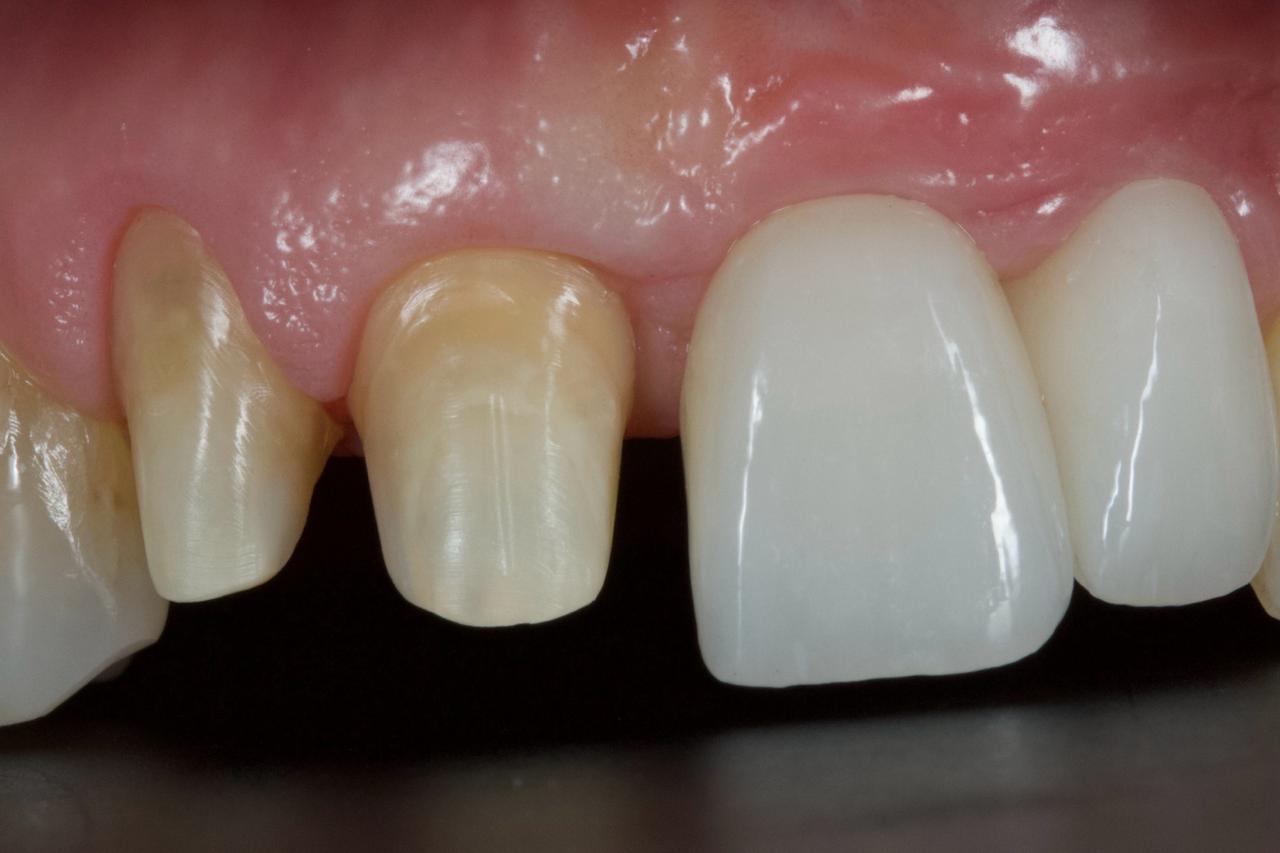
Self-adhesive cements promise speed and simplicity — no etching, no primer, just mix and seat. In practice that only works if you know exactly what the cement needs from the tooth surface and what is stopping it from doing its job.
01BasicsWhat a self-adhesive cement actually does
Self-adhesive cements (typically RelyX Unicem, MaxCem, SpeedCEM) contain acidic functional monomers — most often MDP or phosphate esters — whose job is to demineralise the tooth surface on their own, penetrate the dentinal tubules and form a chemical bond with hydroxyapatite. But that intrinsic demineralising capacity is limited. Research repeatedly shows that self-adhesive cements penetrate only very shallowly into dentine and remove the smear layer only partially.
In other words: the cement needs hydroxyapatite to grip onto. If a thick smear layer or over-dried dentine stands in the way, the bond will be weak — regardless of what the manufacturer promises.
02Smear layerEnemy number one
The smear layer forms with every cut. It is a sticky film of crushed dentinal debris, bacteria and residue that plugs the dentinal tubules and physically blocks the cement from reaching the hydroxyapatite. Self-adhesive cements cannot reliably remove it on their own — Monticelli et al. (2008) confirmed this, showing only minimal penetration of self-adhesive cement into dentine without prior surface treatment.
The fix is simple: a short etch with phosphoric acid. But watch out — where and for how long matters.
03ProtocolEnamel and dentine are not etched the same way
This is the crux of the whole thing, and where most mistakes happen.
Enamel is barely etched by a self-adhesive cement on its own. Without a prior phosphoric acid etch, the bond to enamel is markedly weaker than the bond to dentine. Rohr et al. (2022) showed that RelyX Universal reached its highest bond strength on enamel precisely with the combination of selective enamel etching and a primer. Enamel tolerates a standard 15–30 second etch — it is mineralised, robust, and the acid simply opens it up for mechanical retention.
Dentine is a different story. Phosphoric acid etching longer than 10–15 seconds over-etches the dentine — it strips hydroxyapatite too deep, exposes the collagen network that collapses without a bonding agent, and the resulting bond ends up worse than if you had not etched at all. A self-adhesive cement needs hydroxyapatite present at the surface in order to bond to it chemically.
The correct approach is selective enamel etching — phosphoric acid on enamel only, 15–30 seconds, leaving the dentine untouched. But if you want to remove the smear layer from dentine while still preserving the hydroxyapatite, there is a compromise: a very brief dentine etch of 5–10 seconds. An exposure this short removes the coarse smear layer but does not disturb the hydroxyapatite structure enough to deprive the cement of its chemical anchor point. Hammal et al. (2021, PeerJ) confirmed that phosphoric acid etching of dentine has no negative effect on the bond strength of MaxCem — for some cements it actually improved it slightly.
04DryingHow much is enough
And now to the question that this whole article exists for: how much should you dry the tooth before seating the crown?
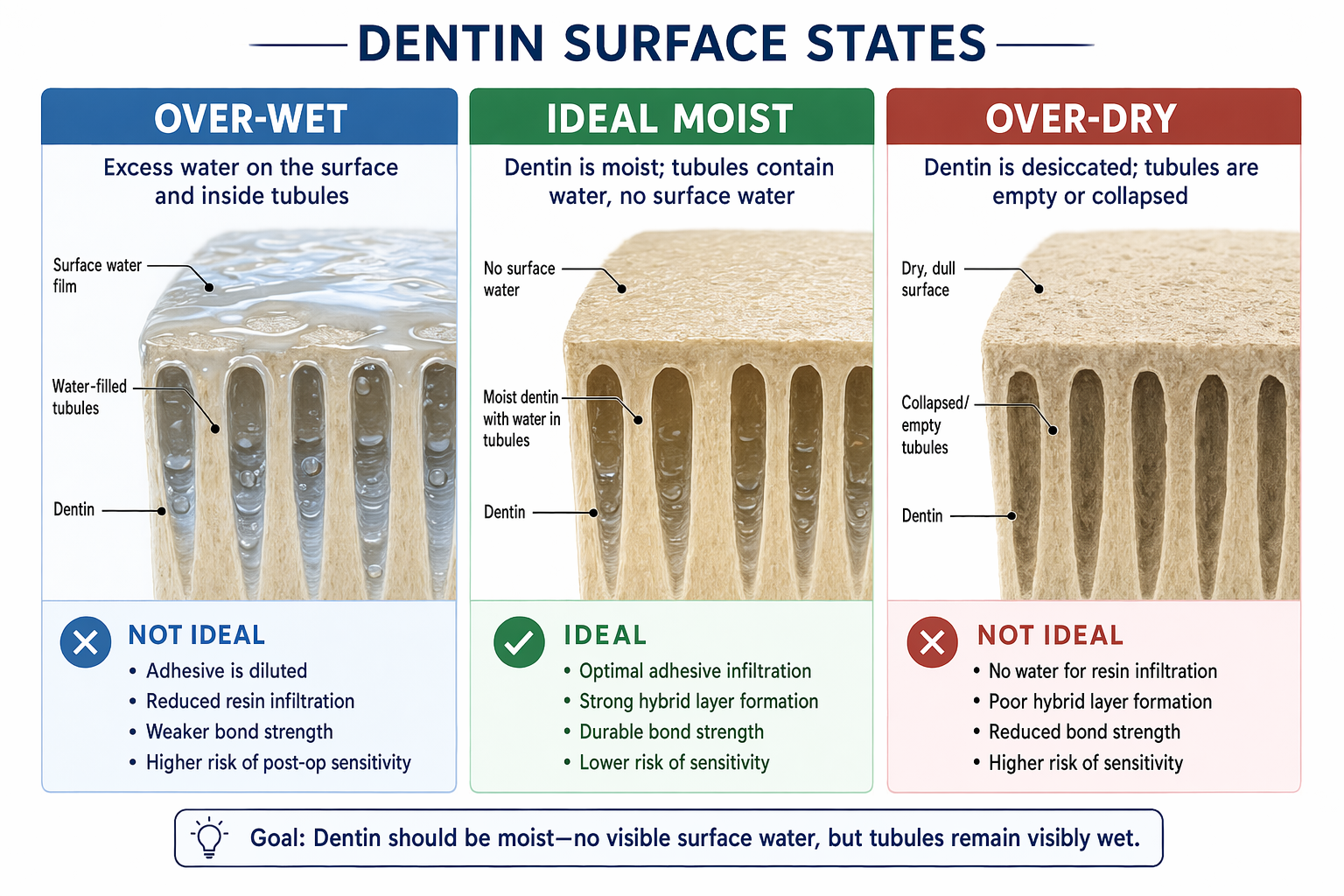
The answer is slightly moist, not wet, but not over-dried either. Self-adhesive cements need a certain amount of moisture so that their acidic monomers can ionise and react with the hydroxyapatite. Over-dried dentine — typically after aggressive air blasting — collapses the collagen fibres and closes the tubules. The cement then has nowhere to penetrate.
In practice: after rinsing off the acid and drying the enamel, leave the dentine just lightly moist. A gentle air stream for 1–2 seconds from a greater distance is enough. The surface should look matt-glossy — not wet, not chalky white.
05SummaryThe four steps that decide it
A self-adhesive cement does a solid job, provided you set up the right conditions for it:
- Remove the smear layer — a short dentine etch (5–10 s) or at least a thorough rinse.
- Etch enamel the standard way (15–30 s) — a self-adhesive cement on unetched enamel simply is not enough.
- Preserve the hydroxyapatite on dentine — do not over-etch, do not over-dry.
- Leave the dentine slightly moist — a matt-glossy surface is the right signal.
Self-adhesive cements are an excellent tool for fast and reliable fixation — but only when you know what they need from the tooth surface. The protocol is not complicated. You just have to know it.

👨⚕️ doc. MUDr. Radek Mounajjed DDS., PhD. 🦷 D.C.M. Clinic 🎓 Associate Professor, Palacký University Olomouc, Czech Republic 📚 CICERO Cofounder ⚖️ Certified Court Expert in Dentistry
View educator profile