
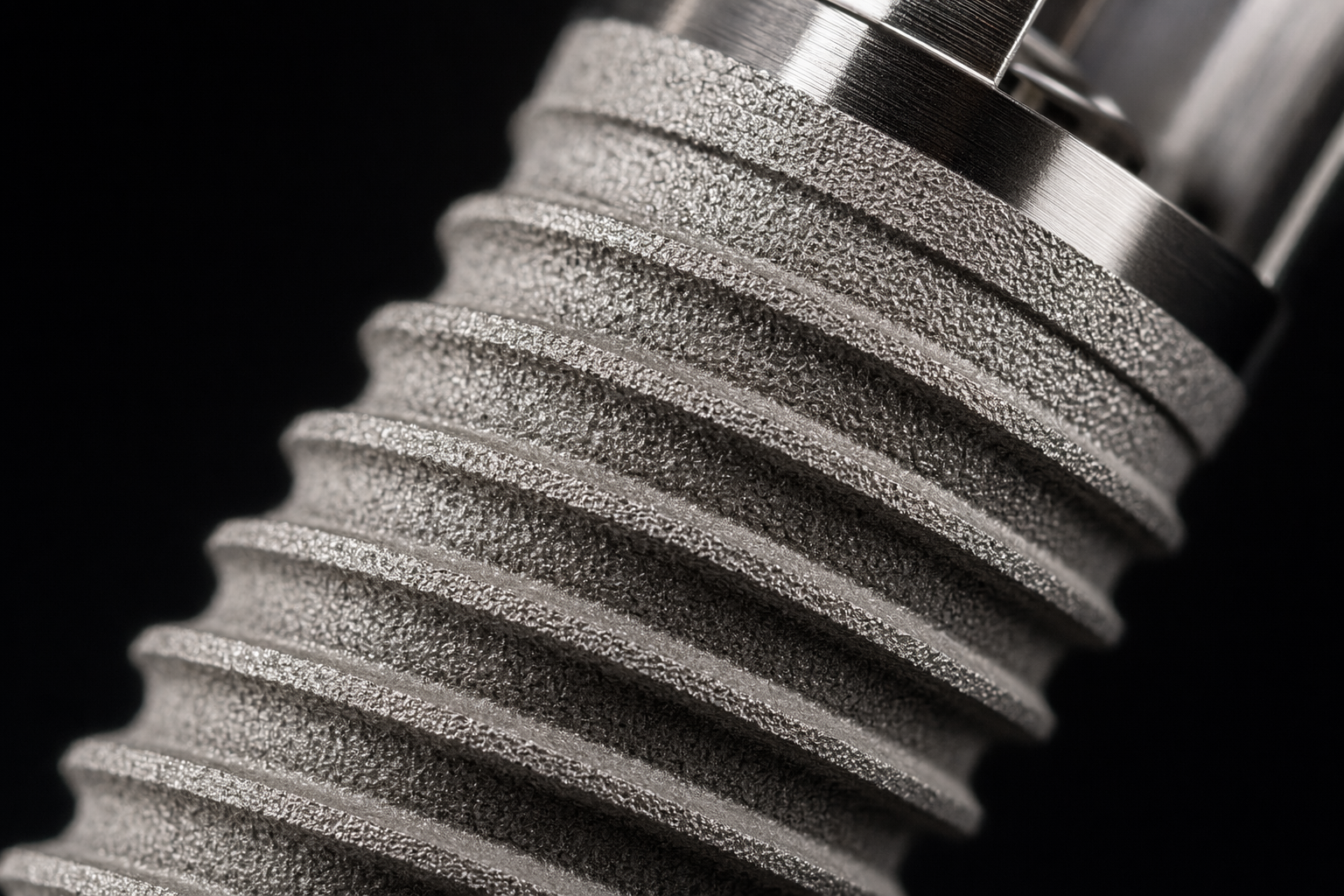
Pick up any dental implant and you are holding what looks like a simple screw. Turn it under the light and the surface tells a different story — a landscape of craters, ridges, and nano-scale chemistry engineered to trigger a very specific biological conversation with bone. That conversation, more than thread geometry or alloy composition, is what separates a well-integrated implant from one that never fully commits.
01The BasicsWhy Surface Roughness Is Not Just a Number
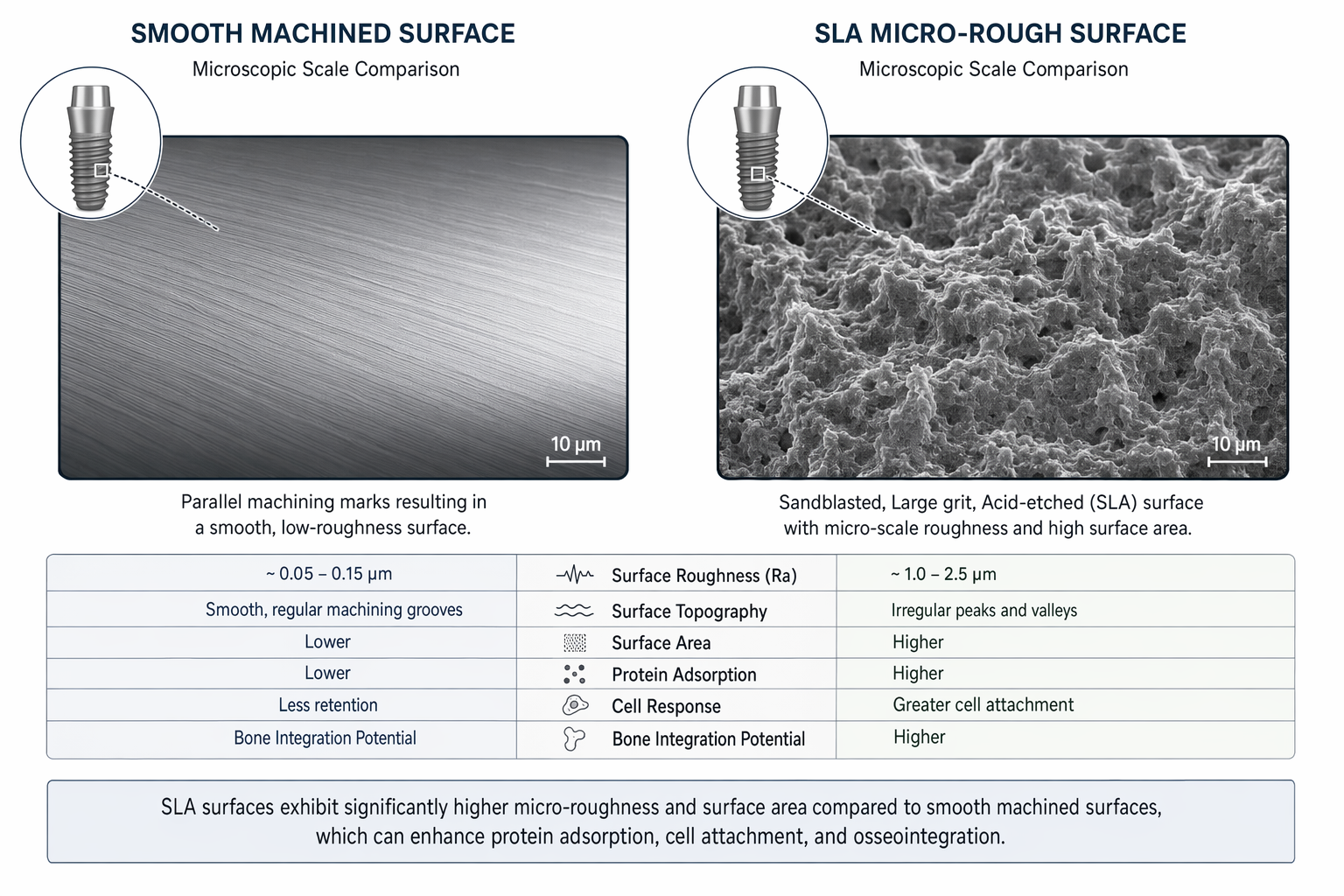
Osseointegration is not passive. The moment an implant contacts blood, a cascade begins: protein adsorption, platelet activation, macrophage recruitment, and ultimately osteoblast differentiation. Surface topography shapes every step of that cascade. Moderately rough surfaces — typically in the Sa 1–2 µm range — consistently outperform both machined (smooth) and excessively rough surfaces in bone-to-implant contact (BIC) studies.
The mechanism is mechanical and biochemical at once. Micro-scale roughness increases the real contact area between titanium oxide and mineralizing bone matrix. Nano-scale features on top of that roughness guide cell morphology: osteoblasts on structured nano-topographies flatten, extend lamellipodia, and upregulate osteogenic transcription factors such as Runx2 more readily than on featureless surfaces. A 2026 narrative review in Cureus confirmed that moderately rough surfaces combined with optimised macro-geometry represent the most consistently evidence-supported approach to achieving reliable osseointegration.
02The SLA StandardSandblasting, Acid-Etching, and What Comes After
The sandblasted, large-grit, acid-etched (SLA) protocol became the reference standard for implant surfaces over the past two decades — and for good reason. Large-grit blasting creates macro-pits in the 10–100 µm range; subsequent acid etching overlays micro-pits of 1–3 µm. The result is a hierarchical topography that promotes fibrin clot retention and osteoblast attachment simultaneously.
The next evolution was wettability. A standard SLA surface, once exposed to air, accumulates hydrocarbon contamination that raises the water contact angle and reduces surface energy. Storing the implant in isotonic saline — keeping the surface chemically clean and superhydrophilic — measurably accelerates early BIC formation. Preclinical data show that hydrophilic SLA variants achieve significantly higher bone area and BIC at 14, 21, and 28 days compared to their hydrophobic counterparts. The clinical translation is real: faster secondary stability, shorter healing protocols, and more predictable loading timelines.
ZimVie's MTX (Micro-Textured) surface follows this logic precisely. The MTX surface combines large-grit blasting with acid etching to produce a controlled micro-rough topography in the clinically validated Sa range, and the implants are packaged to preserve surface cleanliness and wettability from the factory floor to the surgical site. It is a surface designed around the biology, not around the manufacturing process.
03Beyond TitaniumWhen the Scaffold Becomes the Surface
Some of the most compelling surface science of the last decade has moved beyond chemistry and into three-dimensional architecture. Trabecular bone — the cancellous network inside the jaw — has a porosity and interconnectivity that no flat surface can truly replicate. The question engineers asked was: what if the implant surface was trabecular?
ZimVie's Trabecular Metal technology, derived from tantalum, answers that question directly. The material's open-cell structure mimics cancellous bone at the macro-scale, with pore sizes and interconnectivity that allow vascular ingrowth and direct bone deposition inside the implant body — not just on its outer surface. Tantalum's elastic modulus is also closer to cortical bone than titanium, which reduces stress shielding at the bone-implant interface. For compromised bone sites — post-extraction sockets, grafted ridges, patients with reduced bone density — this architecture offers a fundamentally different biological starting point.
Surface modifications that promote rapid and stable osseointegration are among the most critical factors determining long-term implant success.
Smeets R. et al. · Biomed Research International, 2016
04The Immune LayerWhy Macrophages Matter More Than We Thought
The newest chapter in implant surface science is osteoimmunology. Bone healing is not just an osteoblast story — it is an immune story first. Macrophages arrive at the implant site before osteoblasts do, and their polarisation state (pro-inflammatory M1 vs. regenerative M2) sets the trajectory for everything that follows.
Micro-nano hybrid topographies — surfaces that combine micron-scale roughness with nanoscale features — have been shown to shift macrophage polarisation toward the M2 phenotype, reducing TNF-α and IL-6 expression while upregulating CD206 and Arg1. The downstream effect is enhanced osteogenic differentiation of mesenchymal stem cells and improved angiogenesis. A 2026 study in the International Dental Journal identified the YAP/Piezo1/AKT/ERK signalling axis as the mechanotransduction pathway through which surface topography communicates with immune cells. This is not incremental refinement — it is a new design dimension for implant surfaces.
The practical implication: surface choice is no longer just about roughness and wettability. It is about engineering an immune microenvironment that actively supports regeneration rather than merely tolerating the implant.
05Choosing WiselyWhat the Evidence Supports in Practice
Not all surfaces are equal, and not all clinical situations call for the same surface. Machined surfaces remain appropriate for transmucosal components where bacterial resistance matters more than BIC. Moderately rough SLA-type surfaces are the evidence-backed default for the osseointegrating body of the implant. Hydrophilic variants of those surfaces offer a measurable advantage in early healing — particularly relevant for immediate or early loading protocols. Three-dimensional porous architectures like Trabecular Metal address a different problem entirely: sites where conventional surface chemistry is not enough because the bone volume or quality is insufficient to begin with.
The implant companies that invest in surface science — not just surface marketing — tend to be the ones whose long-term survival data hold up under scrutiny. ZimVie's portfolio, built on decades of Zimmer Biomet research, reflects that investment: the MTX surface for predictable everyday osseointegration, and Trabecular Metal for the cases where the biology needs more than a rough titanium screw.
Surface science is not a footnote in implant dentistry. It is the mechanism by which the whole enterprise works.

👨⚕️ doc. MUDr. Radek Mounajjed DDS., PhD. 🦷 D.C.M. Clinic 🎓 Associate Professor, Palacký University Olomouc, Czech Republic 📚 CICERO Cofounder ⚖️ Certified Court Expert in Dentistry
View educator profile