
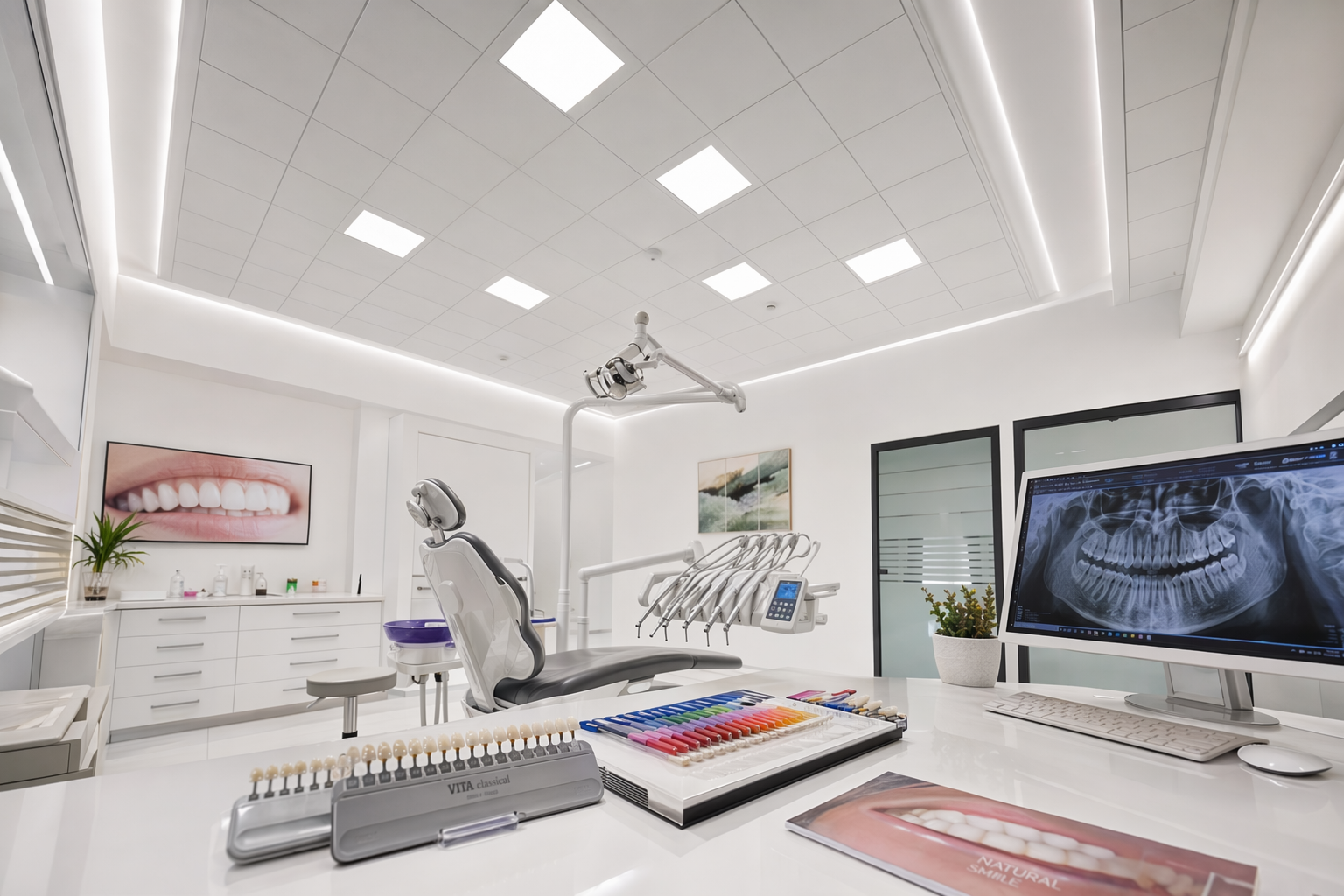
You come into the office, pick up the Vita 3D-Master, and confidently choose a shade. The patient comes in for the crown try-in — and the color doesn't match. The technician did exactly what you sent. The mistake wasn't in the lab. The mistake was in the light above your head.
01Why It MattersLight as a Clinical Instrument
Office lighting is not an interior-design matter — it is a clinical variable. A study published in The Journal of Prosthetic Dentistry (Labis et al., 2025) tested the accuracy of visual tooth-shade determination under various light sources and found that modern LED lamps on dental units, set to the correct color temperature and intensity, achieve accuracy comparable to a standardized D55 daylight lamp. The key phrase: set to the correct temperature.
Generic LED panels from the hardware store do not meet this condition. And this is exactly where the problem in most offices begins.
02Three Numbers You Must KnowCRI, CCT, and Lux
Before you order anything from an online shop, learn three parameters. They are the only things on the box you should actually read.
CRI — Color Rendering Index A number from 0 to 100 indicating how faithfully a light reproduces colors compared with natural daylight. For a dental office there is one rule without exception: CRI ≥ 90, ideally ≥ 95. Below 90, the colors of teeth, gums, and composites begin to look different from what they are. Cheap office panels tend to have a CRI of 80 — they look white, but clinically they are blind.
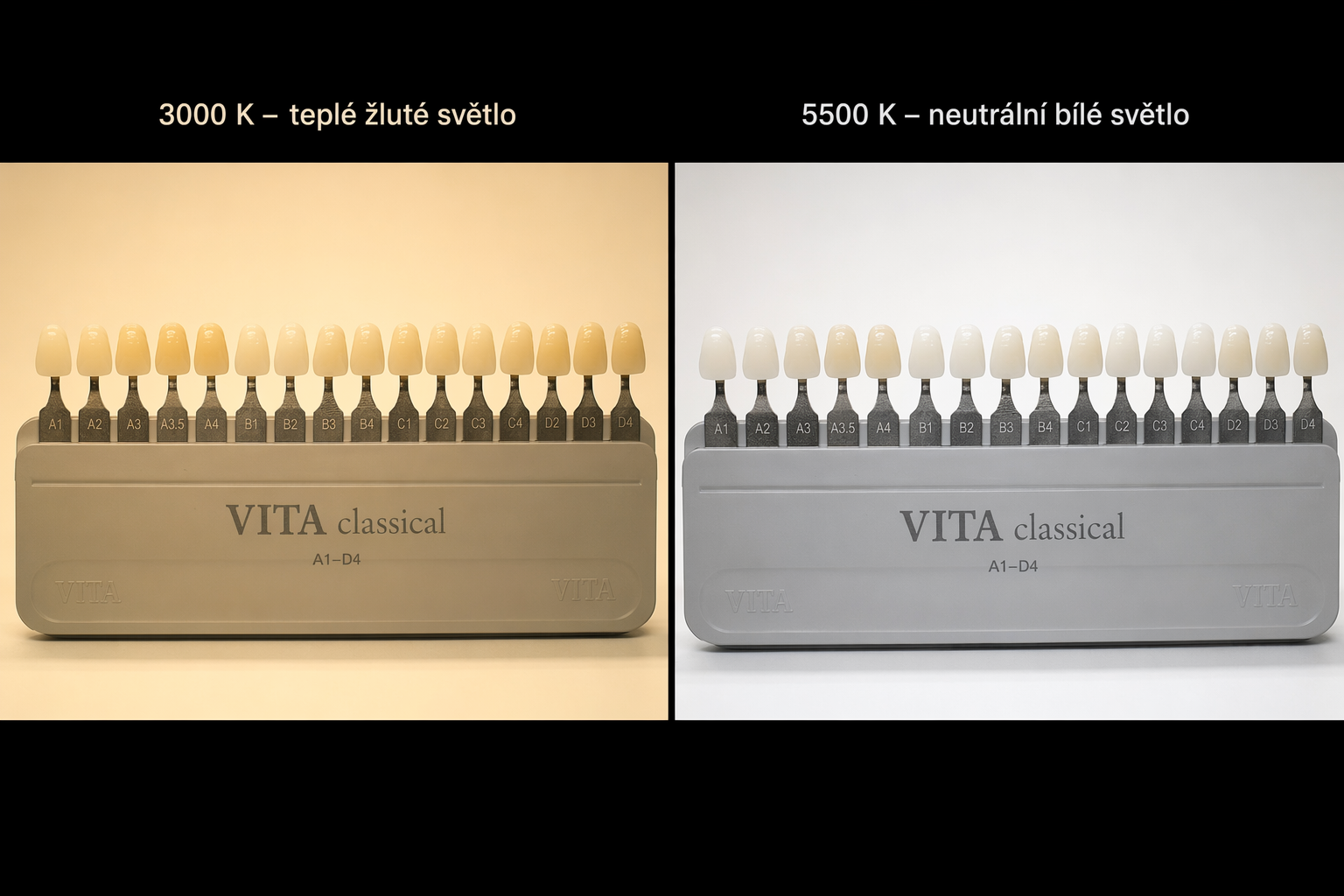
CCT — Correlated Color Temperature Expressed in kelvins (K). Warm light (2,700–3,000 K) is cozy in a café, but in the office it distorts the yellow tones of teeth. Cold light (6,500 K+) is aggressive and tires the eyes. For visual tooth-shade selection the optimal range is 5,000–5,500 K — corresponding to the D55 standard, that is, northern daylight at noon. If you have a panel with adjustable CCT, set it right here every time you select a shade.
Lux — illumination intensity Lux measures how much light actually reaches a surface. The working surface in the office should have at least 500 lux, ideally 750–1,000 lux. Less means eye fatigue and errors in detail. More than 1,500 lux on ceiling panels (not on the operating light) starts to become counterproductive — it glares and creates distracting shadows.
03What to AvoidThe Most Common Mistakes When Choosing
Here is a list of decisions that look reasonable but will harm you clinically:
- "It's 6,500 K — that's daylight, isn't it?" It isn't. 6,500 K is an overcast sky in winter — bluish, cold, distorting the red tones of gums and composites. D55 is 5,500 K.
- "CRI 80 is enough, it's just ceiling light." It isn't enough. The ceiling light is what you do 90% of your clinical work under. The operating light shines directly into the mouth — the ceiling light shines on you, on the shade guide, on the patient sitting in the chair.
- "Let's buy the cheapest panels and save money." You save 3,000 CZK on the panels and spend 15,000 CZK redoing the crown because the color doesn't match.
- "The manufacturer says it's for healthcare." Healthcare lighting is a broad category. Operating theaters have different requirements than dental offices. Always ask for specific CRI and CCT values — not a marketing description.
- "Adjustable color temperature is a pointless luxury." On the contrary — a panel with a 3,000–6,000 K range and a setting memory is an investment that pays off with the first remake you avoid.
04A Practical ChecklistWhat to Tell Your Supplier
Next time you deal with office lighting — whether a renovation or a replacement of existing panels — ask the supplier exactly these questions:
- What is the panel's CRI? (You want ≥ 95; accept nothing below 90.)
- What is the CCT? Is it adjustable? (You want 5,000–5,500 K or an adjustable range that includes this interval.)
- How many lux does the panel deliver at a height of 80 cm above the floor (= the height of the working surface)? (You want 750–1,000 lux.)
- Is the panel certified for healthcare spaces? (A bonus, not a requirement — but it speaks to manufacturing quality.)
- What is the lifespan and the warranty on maintaining the parameters? (Cheap LED panels degrade — CRI drops after 10,000 hours of operation.)
The accuracy of visual tooth-shade determination under modern LED lamps on dental units is comparable to a standardized D55 daylight lamp — but only when they are set to the correct color temperature and intensity.
Labis et al. · The Journal of Prosthetic Dentistry, 2025
05BonusTooth-Shade Selection: A Ritual, Not a Gamble
Even with perfect panels, there are a few rules that are easily forgotten in practice. Always select tooth shade:
- At the start of treatment, not after an hour of work — tired eyes see differently.
- Without heavy makeup in the field of view — lipstick distorts the perception of color contrast.
- After wetting the tooth — a dry tooth appears optically lighter.
- Under the ceiling light, not the operating light — the operating light is too intense and directional.
Light in the office is not a detail. It is the first instrument you switch on every morning — and the last one you think about. Maybe it's time to change that.

🌍 Cicero System🎓 Dental Education | 🛒 Procurement | 🏥 Clinic Management