
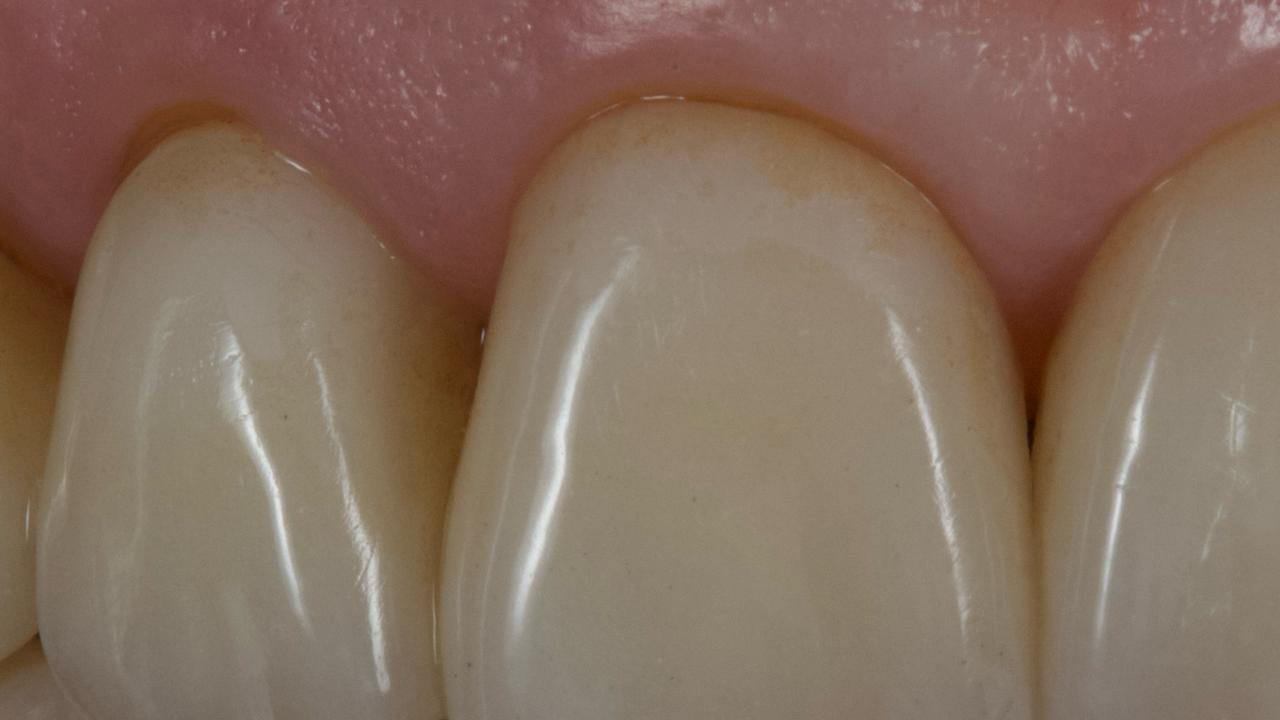
A ceramic crown or veneer looks perfect after cementation — a smooth, glossy surface that reflects light just like natural enamel. But every day the patient steps in front of a mirror twice, picks up a brush and slowly starts grinding the glaze down. The question isn't whether it will happen, but how fast.
01The glaze under the microscopeWhat happens during every brushing
The glaze is a thin glassy layer fired onto the ceramic surface — its thickness is on the order of micrometres. It protects both the aesthetics and the biocompatibility of the restoration: a smooth surface holds less plaque, resists pigmentation and keeps the gloss.
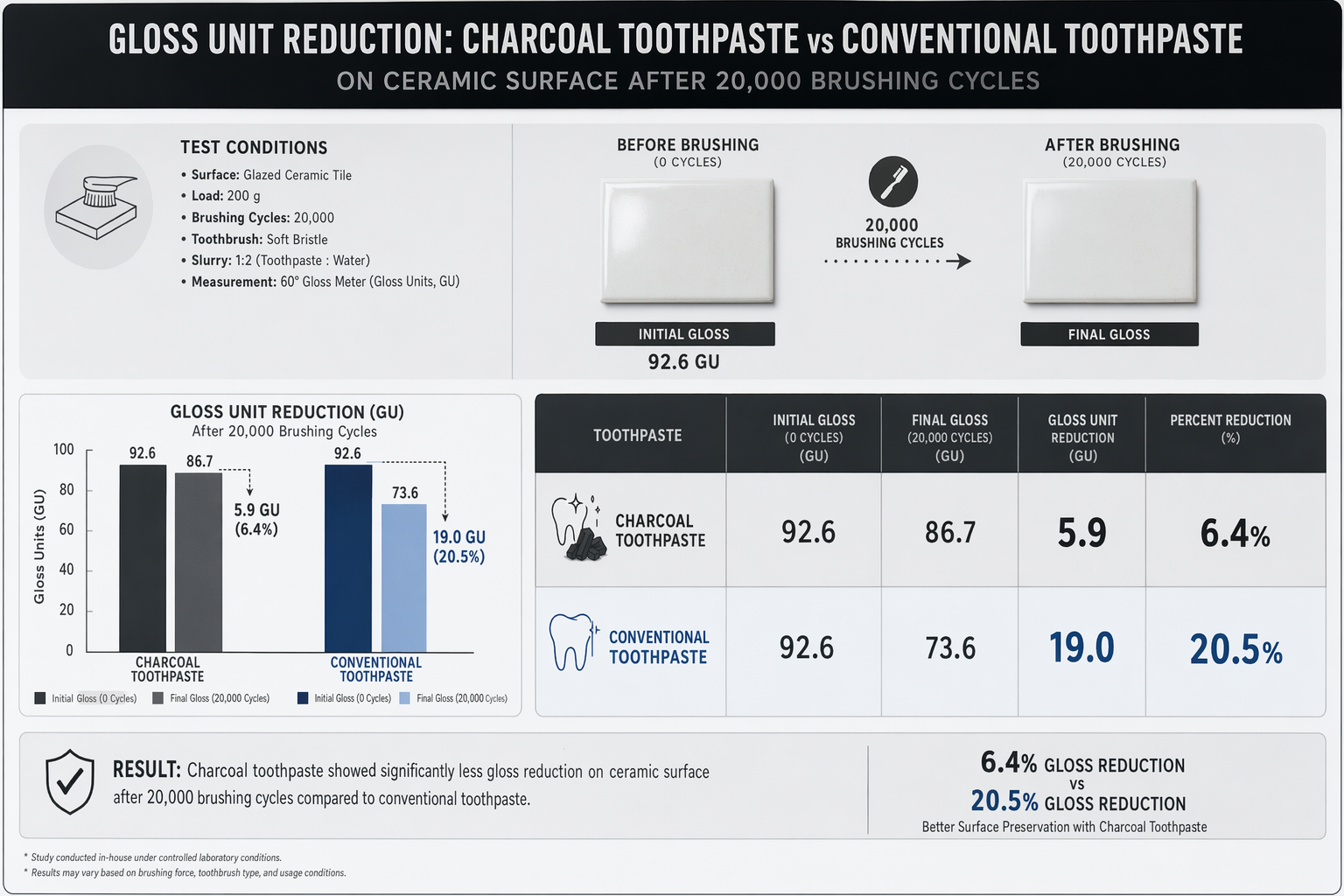
With every brushing, the abrasive particles in the paste move across this surface and mechanically wear it. The result is a gradual increase in roughness (Ra) and a loss of gloss (GU — gloss units). Research on glazed lithium-disilicate ceramics (IPS e.max CAD) has shown that after 20,000 brushing cycles gloss can drop by more than 20 GU — while conventional pastes with a low RDA show practically no such effect, charcoal-based pastes cause statistically significant surface damage.
02The biggest culpritCharcoal pastes and whitening abrasives
Trendy "black" charcoal pastes have become very popular in recent years. The problem is that carbon particles have irregular shapes and high hardness — and research confirms the impact. A study on glazed e.max samples showed that charcoal pastes increase surface roughness and reduce gloss significantly more than the conventional paste Colgate Total 12. The conventional paste actually increased gloss after 20,000 cycles — thanks to a mild polishing effect.
Strongly whitening pastes with a high content of hydrated silica or sodium bicarbonate are similarly risky — their RDA can exceed 150.
03The long viewWhat the clinical research says
The good news: standard daily brushing with a paste of reasonable RDA does not fundamentally threaten the glaze of a ceramic. A study evaluating glazed CAD/CAM materials (lithium disilicate, zirconia ceramic) after 180,000 brushing cycles found that surface roughness actually decreased across all tested materials after long-term brushing — the brushing had a polishing effect instead. Key condition: use a paste with a low-to-medium RDA.
04How to check it in 10 secondsCicero Assistant knows the RDA of every paste
A patient comes in for a recall and mentions a new "whitening" paste. Instead of digging through package inserts or the manufacturer's website, just open Cicero Assistant and type the paste's name — the assistant instantly returns the RDA value and a recommendation on whether the paste is suitable for patients with ceramic restorations.
Cicero Assistant can answer the query "what's the RDA of Sensodyne Repair & Protect?" instantly — without leaving your workstation or searching through manufacturers' technical sheets.
Cicero Team · Cicero Education, 2026
For patients with ceramic crowns, veneers or an e.max crown we recommend pastes with an RDA below 70 — typically pastes for sensitive teeth (Sensodyne, Elmex Sensitive) or children's pastes for adults. Whitening pastes with RDA over 100 and charcoal pastes should not be recommended unless the manufacturer's RDA figure is available.

👨⚕️ doc. MUDr. Radek Mounajjed DDS., PhD. 🦷 D.C.M. Clinic 🎓 Associate Professor, Palacký University Olomouc, Czech Republic 📚 CICERO Cofounder ⚖️ Certified Court Expert in Dentistry
View educator profile