
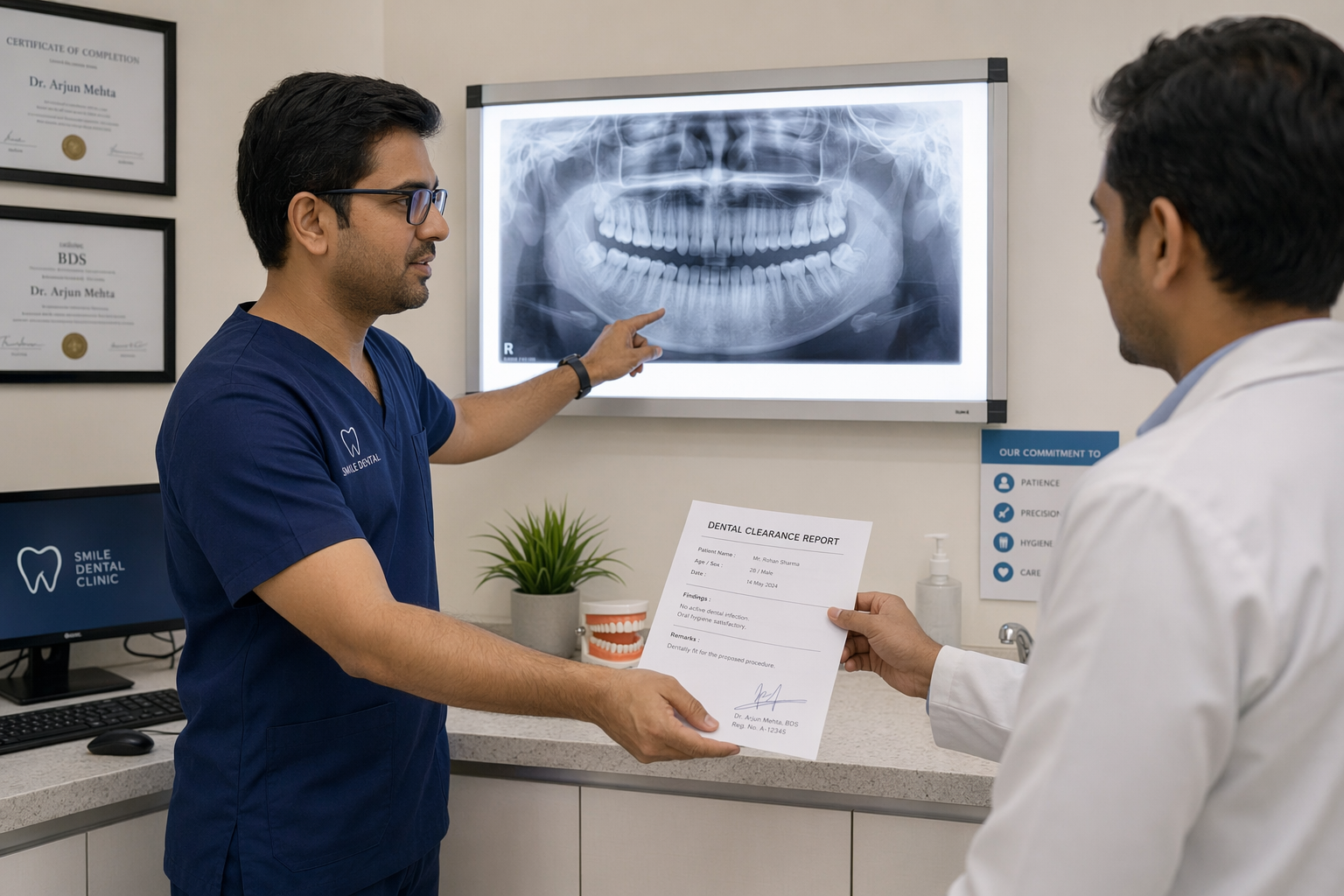
A cardiologist writes three words on the request form: rule out focal infection. A rheumatologist does the same. So does an oncologist before starting bisphosphonates. The dentist receives the paper, the patient sits in the chair – and the question begins: what does this actually mean and what is the expected output?
01Why this is askedThe logic behind the request
A focal infection is a chronic or subacute focus in the oral cavity that, under normal circumstances, the body tolerates. But once the immune or pharmacological context changes – immunosuppression after transplantation, antiresorptive therapy, biological treatment or prosthetic-valve surgery – the tolerated focus becomes a source of bacteraemia or local necrosis with potentially serious systemic consequences.
The key principle is simple: an invasive procedure in infected tissue after the risk therapy has started is more dangerous than the same procedure before it. That is why dental clearance is performed preventively, in the window before therapy begins, when the tissues still heal in a standard way.
02Bisphosphonates and denosumabThe strictest window
Before starting antiresorptive therapy (bisphosphonates, denosumab) – particularly in oncological indications administered intravenously – dental clearance is the best-documented prevention of MRONJ (medication-related osteonecrosis of the jaw). The 2019 MASCC/ISOO/ASCO international guidelines recommend a comprehensive dental examination, identification of modifiable risk factors and avoidance of elective dentoalveolar surgery once therapy has begun.
What specifically to treat before therapy starts:
- Extractions of teeth with infaust prognosis (periapical lesions, advanced periodontitis, residual roots)
- Endodontic treatment of teeth with a periapical finding where preservation is realistic
- Periodontal treatment – scaling, root planing, elimination of deep pockets
- Removal of ill-fitting prostheses or sharp margins causing chronic mucosal trauma
Time window: ideally 4–6 weeks before therapy starts, so that extraction sites heal with bone. With oral bisphosphonates for osteoporosis the MRONJ risk is markedly lower, but the principle of pre-treatment clearance remains.
03Heart-valve replacement and cardiac surgeryEndocarditis as a real risk
Oral bacteria – especially Streptococcus viridans, Enterococcus and periodontal pathogens – are proven causes of infective endocarditis on prosthetic valves. Cardiac surgeons therefore require dental clearance before an elective operation in order to eliminate a potential source of bacteraemia in the postoperative period, when the prosthesis is not yet endothelialised.
Practical content of the dental examination before cardiac surgery:
- Panoramic radiograph (OPG) + full intraoral X-ray status as the baseline – periapical lesions, residual roots, horizontal bone loss
- Clinical periodontal examination (BOP, pocket depths)
- Assessment of mucosa and potential chronic traumas
- CBCT as a complementary investigation when indicated
The output isn't just a list of findings – the cardiologist needs an explicit statement on whether active infectious foci are present, and if so, whether they have been or will be treated before the operation. A vague report saying "dental treatment completed" without specifics is not enough.
The occurrence of pre-transplantation dental infection that led to deferral or cancellation of the procedure was reported in 38% of transplantation centres.
Guggenheimer J. et al. · Clinical Transplantation, 2005
04Transplantation and biological therapyImmunosuppression changes the rules
Before organ transplantation (liver, kidney, heart) and before starting biological therapy (anti-TNF, anti-IL, JAK inhibitors) the same logic applies: a focus that an immunocompetent body manages can, under immunosuppression, cause systemic sepsis. A survey of US transplantation centres showed that 80% routinely require a pre-transplant dental examination.
In patients with rheumatoid arthritis, psoriatic arthritis or ankylosing spondylitis on biological therapy, a higher prevalence of oral fungal infections and periodontal changes is also documented – which, in turn, complicates the underlying disease.
Specifics for this group:
- Dental clearance should be completed before immunosuppression starts, not in parallel with it
- Periodontitis and rheumatoid arthritis are linked in both directions – treating the periodontal disease can favourably influence the activity of the underlying condition
- After biological therapy has started, invasive dental procedures remain possible but require coordination with the rheumatologist (timing relative to the biologic dose, possible antibiotic prophylaxis)
05What to put in the reportA format your colleagues will appreciate
A report to the referring specialist should contain:
- Date of examination and imaging methods used
- List of findings with a clear indication of whether an active infectious focus is present (yes/no)
- Description of the treatment performed or planned, with an estimated completion date
- Explicit conclusion: "As of [X], no active focal infectious foci are present in the oral cavity" – or, conversely, with a description of what remains to be addressed
The dentist acting as a consultant to other specialties isn't just "the one who pulls teeth before surgery". They are a clinical partner whose report directly influences the timing and safety of systemic therapy. The more accurate and structured the output, the better for the patient – and the fewer phone calls from cardiologists who don't know what to take away from the report.

🌍 Cicero System🎓 Dental Education | 🛒 Procurement | 🏥 Clinic Management